• Home
  • About
  • Contact

Expanding The Horizons

  • Cool Trauma

    February 9th, 2026

    There was a time when sadness was quiet and stylish. Aamir Khan walking alone in Tanhaai, earphones on, Sydney doing the emotional background work. He was sad, but not announcing it. No explanations. No audience. Just a song and a slow walk. Sadness had dignity back then.

    Now I open Instagram and everyone has trauma. Trauma from loss. Trauma from love. Trauma from childhood. Trauma from adulthood. Trauma from food. And yes, finding a dead fly in your burger at the last bite is also emotionally disturbing. I am not ranking pain. Pain is democratic.

    But that is not my problem.

    My problem is that I cannot stay stressed for long. Stress comes, messes with my sleep, affects my body, overstays its welcome, and then my system politely throws it out. Like a guest who has talked enough about their problems and needs to leave now.

    Instagram does not understand this concept.

    I do not like trauma reels. I do not engage. I just want a dog video or someone failing at cooking. Still, trauma keeps finding me. Healing trauma. Unhealed trauma. Childhood trauma explained in thirty seconds with sad music. At some point, I start wondering if something is wrong with me.

    Why do I not want to sit with sadness all day. Why do I not want to keep revisiting pain. Why does my mind prefer moving on instead of making content out of it.

    Then I read this line. Joy does not need words. Loss does.

    That suddenly made sense.

    When you are happy, you just point at things. This. That moment. That laugh. Joy is simple and selfish. It does not explain itself. It does not need captions. Loss is different. Loss leaves an empty space, and empty spaces make us uncomfortable. So we fill them with words. Long words. Heavy words. The dictionary shows up because the thing itself is missing.

    That is probably why sadness writes better. Pain wants language. Joy just wants to exist.

    Maybe nothing is wrong with me. Maybe I just do not like living inside loss for too long. I feel things, process them, and then I want quiet. Not a reel. Not a performance. Just silence and a return to normal life.

    So no, I am not broken.

    Some people write because something is gone.

    Some people stay quiet because something is still here.

    And honestly, I am okay being the second kind.

  • I want a Wedding.

    February 5th, 2026

    I have been craving a wedding lately, and before you jump to conclusions, let me clarify that I do not want to get married, remarried, pre-married, or emotionally ambushed. I simply want to see a wedding. A proper one. The kind that happens by a river, with mountains standing quietly in the background like responsible elders who do not interfere. The sun should be setting at the horizon, doing that golden-hour thing photographers talk about, and the breeze should be cool enough to remind you that life can be gentle sometimes.

    There should be food. Real food. The kind whose aroma reaches you before the waiter does. Food that makes you rethink all your life decisions related to portion control. As I sit there, colours should be mixing around me in perfect harmony, not the loud wedding colours that attack your eyes, but tasteful ones that whisper happiness instead of shouting it. Everything should look like it belongs exactly where it is.

    And me. I am not part of it. This is important. I am sitting on a chair. A chair placed slightly to the side. Not the front row, not the family row, just a good observational angle. I am not participating, not dancing, not clapping on cue, not being pulled into group photos. I am there only to witness. Like a spectator in a live match where emotions are running high but none of the pressure is mine.

    I want to watch people smile without wondering if I should be smiling too. I want to hear laughter without being asked why I am quiet. I want to enjoy love without being required to explain my relationship status, my life timeline, or my future plans. I want to see banter, teasing, inside jokes, and those small moments where people forget the camera is watching them. I want to borrow joy for a few hours and return it respectfully.

    At some point during this fantasy, my brain does ask a very adult question. Is this normal. Is wanting to sit quietly at someone else’s happiness a sign of something being wrong. Should I be concerned that I want the beauty but not the involvement. Then I remember how exhausting participation has become. Every event now demands energy, opinions, explanations, and a performance. Sometimes you do not want to be a character. Sometimes you just want to be the audience.

    This is not sadness. This is not detachment. This is not fear of love. This is emotional bandwidth management. This is wanting peace without paperwork. This is choosing a chair over the stage because the chair lets you breathe.

    Maybe this craving exists because life lately has been noisy. Deadlines, responsibilities, expectations, and constant engagement leave very little room to simply observe something good without being questioned. A wedding like this becomes a safe place. A place where happiness exists independently of you, and you are allowed to enjoy it without earning it.

    So no, this is not a mental illness. If anything, it is a sign of awareness. It is the understanding that joy does not always require participation. Sometimes the most satisfying thing you can do is sit quietly, feel the breeze, smell the food, watch the sun go down behind the mountains, and think that love is still happening in the world, and for now, that is enough.

    Later.

  • Peace of not knowing everything

    January 29th, 2026

    I saw a 13-second clip today.

    A boy sitting peacefully, eating his pohe. Nothing dramatic. No background music. No life lesson being preached. Just a child enjoying his food with complete sincerity.

    The caption read, “Peace of not knowing everything.”

    What stayed with me was not the food. It was the expression on his face. Pure contentment. No hurry. No calculation. No silent mental noise.

    Scrolling through the comments felt strangely personal. People kept saying they did not know when they lost that peace. And that hit hard, because most of us truly do not remember the moment it disappeared. It was not taken from us overnight. It slowly slipped away while we were growing up.

    As children, hunger meant hunger. You ate when you were hungry. You slept when you were sleepy. Life did not come with options, comparisons, or self doubt.

    Now even eating requires a committee meeting. Is this healthy. Is this allowed. Is this too much. Is this too late. Should I compensate tomorrow. The pohe is still the same, but the mind eating it is exhausted.

    The boy in the video did not know about deadlines, disappointments, red flags, emotional intelligence, financial planning or healing journeys. He also did not know how things end before they even begin.

    And yet, there he was. Completely present.

    Somewhere along the way, we started knowing too much. We learned to anticipate pain. To analyse happiness. To measure moments instead of living them. We did not lose peace because life became difficult. We lost it because our minds never learned to rest.

    I do not want to go back to childhood. But I do miss that version of living where a simple moment did not need justification.

    Maybe peace is not about having everything sorted.

    Maybe peace is just eating your pohe without wondering what it means.

    Later.

  • I’m out of titles

    January 21st, 2026

    Sit by the Ganga long enough and you’ll feel it. The river flows endlessly.

    You sit silently. And suddenly your mind whispers “We are nothing. Temporary travelers.Our fights, ambitions, relationships, achievements are all pointless.”

    You nod slowly, pretending you didn’t just think about quitting your job and becoming a minimalist.

    People nearby assume you’ve reached enlightenment. Because apparently, location matters more than logic.

    Now imagine the same thought arriving elsewhere.

    You’re sitting on the commode.

    Door locked.

    Phone in hand.

    Life paused.

    And the exact same realization hits:

    “Everything is useless.”

    But this time there’s no river.

    No breeze.

    No chanting.

    Only an exhaust fan screaming like it regrets being born. Suddenly, it’s not spirituality anymore. It’s “bro, are you okay?”

    At the ghat, this thought is called awakening. In the bathroom, it’s called depression with Wi-Fi.

    Funny thing is that the thought doesn’t change. Only the aesthetics do.

    The universe doesn’t care where you sit. It sends truth wherever you’re most defenseless.

    Ganga gives you poetry.

    The toilet gives you honesty.

    At the river, your ego dissolves slowly. In the bathroom, it collapses violently. There, stripped of dignity and social performance, you don’t feel divine. You feel replaceable.

    Your career? Optional.

    Your anger? Meaningless.

    Your enemies? Probably asleep.

    Your legacy? One forgotten password away from deletion.

    That’s when it hits hardest. Not “we are part of something bigger.” But:

    “No one is keeping score.” And that’s terrifying. Because if nothing really matters… then all the stress you carry every day was self-inflicted.

    We romanticize suffering only when it looks aesthetic.

    Pain with sunlight = philosophy.

    Pain with tiles = mental breakdown.

    Yet both reveal the same truth. You don’t need holy water to feel small. Sometimes a bad stomach is enough.

    Turns out, enlightenment doesn’t come from the Ganga, it comes when even your ego can’t survive the flush.

    Later.

  • Somewhere Between Comics and Crying Toddlers

    January 18th, 2026

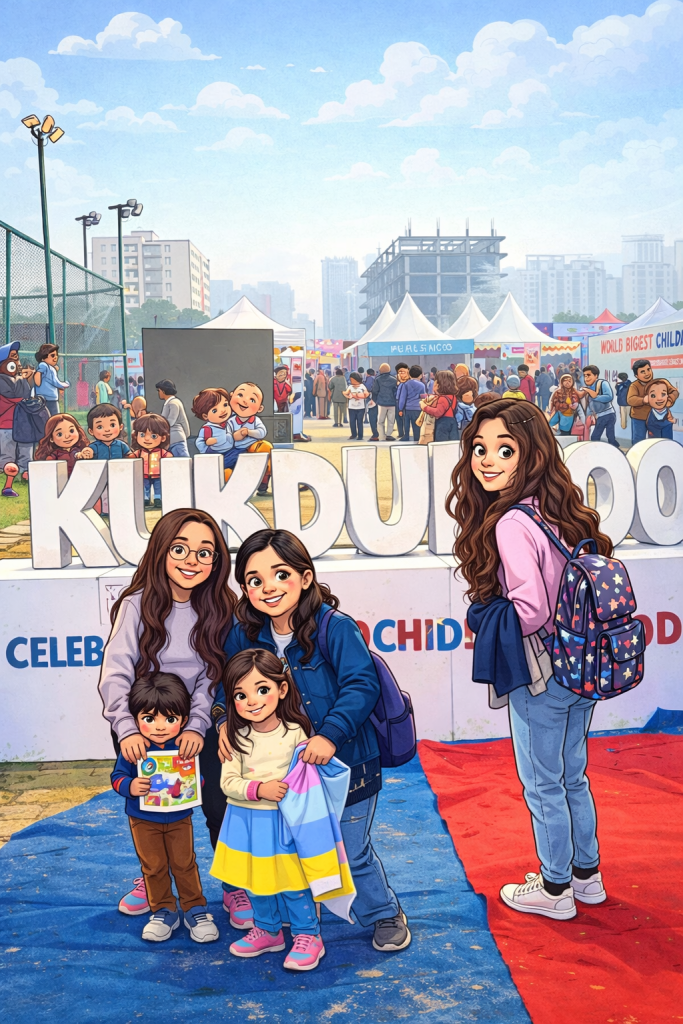
    This weekend, read today, I went to the Kukdukoo Fest with two toddlers.

    One is my son, who turns three in a week. The other is my niece, who turned five last September which basically makes her the senior citizen of the toddler delegation.

    The moment we entered, I realised something was off. Not with the kids.

    With us.

    Because everywhere I looked, there were tired children… and even more tired parents pretending they were “having a family moment.”

    You know the look. The fake smile. The one that says: “Yes, I paid for this.”

    The stage had artists performing, unfamiliar artists. Very unfamiliar. So unfamiliar that even Google would’ve said, “Did you mean… someone else?”

    The kids didn’t care. They were busy running toward balloons, bubbles, and chaos.

    We, the parents, stood there clapping politely, wondering whether this was a concert or a school annual function sponsored by capitalism.

    And then came the stalls. Ah, the stalls.

    Every single one decorated beautifully to gently and lovingly just put a hole in your pocket.

    ₹450 for popcorn.

    ₹600 for something that looked like cotton candy but tasted like regret.

    ₹1,200 for a toy that would be broken before we reached the parking.

    At some point, I saw a Comic Corner.

    Instant nostalgia hit.

    I picked up two comics the kind I used to read lying on the floor, ignoring homework and life responsibilities.

    For a moment, I smiled. Then I realised something terrifying. It didn’t feel the same. Not because the comics were bad but because I wasn’t ten anymore.

    I wasn’t reading them to escape homework. I was reading them while mentally calculating school fees, nap schedules, and whether the kids had eaten enough protein.

    That’s when it hit me.

    Remember when we used to go to concerts? We’d come back exhausted.

    Sweaty. Smelling like someone had secretly puked on us. But we called that great times. Now we come back exhausted, sweaty, smelling like milk, snacks, and emotional burnout and we call it “family outing.” The kids slept in the car. Peaceful. Angelic.

    The parents? Silent.

    As I sat there, holding my comics, watching my son drool in sleep and my niece clutch a free goodie bag like she’d fought a war for it, I realised: Somewhere between childhood concerts and toddler festivals… we didn’t grow up. We just got upgraded responsibilities.

    Ahh. The pangs of old times. May I find peace.…preferably somewhere quiet. With no stage. No stalls. And absolutely no popcorn costing ₹450.

    Later

  • Stranger Things

    January 1st, 2026

    I have always been flayed by Stranger Things.

    Not because of monsters or the Upside Down. But because it feels like childhood. The kind you do not realize you are losing until it is already gone.

    Dustin is my favorite. Always has been. He feels real. He is brave without trying. Funny without forcing it. Loyal in a way only children are. When you see Dustin, you remember how friendships once felt effortless. No filters. No calculations. Just showing up.

    The second half of the finale is pure emotional gold. Everything slows down. The noise fades. What remains are feelings. The kind you sit with quietly. The kind that do not ask for attention but stay long after the screen goes dark.

    Watching Mike write at the end broke something in me. Writing what he could not say. Narrating what he could not fix. Sometimes words come easier on paper. Sometimes that is the only way we survive change.

    And then that moment. Mike seeing Holly play D and D.

    That was not just a scene. That was time folding in on itself. Childhood passing hands without ceremony. One generation stepping out while another steps in. No goodbyes. No announcements. Just a quiet understanding.

    When the door shut at the end, it felt personal.

    It reminded me of school friends. College friends. People who once meant everything. People I laughed with every day. People I thought would always be there. Now they feel like they are behind closed doors. Not gone. Just unreachable.

    You know they exist. You know they are happy somewhere. But you cannot walk back in. Life does not let you.

    Stranger Things hurts because growing up hurts. It is not loud. It is silent. It happens between moments. Between episodes. Between years you do not count.

    The show does not say goodbye properly. And neither does life.

    It made me think of Life of Pi. About how the most important goodbyes do not come with words. No hugging. No final look back. One day someone is with you. The next day they are not. And you never realize that was the last time you would see them.

    Stranger Things ends the same way.

    No dramatic farewell. Just a door closing. And you standing there. Realizing you have already said goodbye.

    Good Night.

  • Vision Board 2026 : Same Trauma, New Font

    December 30th, 2025

    Every new year arrives with the confidence of a motivational speaker and leaves like a distant relative who promised to help but “got busy.” Vision Board 2026 is no different. The only real upgrade this time is emotional maturity. Which, in Indian terms, means carrying all your old trauma into the new year but with less guilt.

    Earlier, trauma came with shame. Now it comes with context. You don’t say “I messed up.” You say “I was surviving.” You don’t say “I made bad choices.” You say “Generational patterns.” Therapy language has given us the gift of accountability without accountability. Same wounds, better vocabulary.

    The vision board says “healing.” Reality says “same issues, different excuses.”

    Indian procrastination deserves its own place on the board. Not as a flaw, but as a lifestyle. We don’t delay work. We marinate it. We let it rest. We believe deadlines are suggestions and pressure is for pressure cookers, not humans. January is for planning. February is for recovering from January. March is when the year actually starts. By April, you’re tired. By May, you’re busy. By June, it’s too hot to grow as a person. July onwards, you’re emotionally preparing for next year.

    Consistency is promised annually and broken weekly.

    Desi family problems, of course, get their own corner on the vision board. You want peace. Your family wants updates. You want boundaries. They want explanations. You want growth. They want marriage. Or a child. Or another child. Or a better job. Or someone else’s child as a comparison chart.

    Every family gathering feels like a performance review where no one knows your job description but everyone is disappointed.

    Then come the New Year goggles. The stupidest tradition of them all. Who decided that numbers should sit on your face like a failed geometry experiment? 2026 is especially cruel. No symmetry. No aesthetic balance. Too many straight lines. Not enough circles. Designers struggle because how do you make “2” look festive without it resembling a broken hanger? How do you celebrate a year whose digits refuse to cooperate?

    Some years are just not photogenic. 2026 is one of them.

    And yet, we will still make the vision board. We will paste words like “discipline,” “abundance,” and “calm.” We will screenshot quotes we won’t read again. We will save reels about morning routines we won’t follow. We will promise ourselves things we couldn’t keep last year but will confidently promise again.

    Because hope, in India, is not optimism. It’s tradition.

    Vision Board 2026 is not about becoming a new person. It’s about becoming slightly more self-aware while staying exactly the same. Same trauma. Same procrastination. Same family WhatsApp groups. Just better captions and lower expectations.

    And honestly, that’s growth.

    Happy New Year!!!???

    Later.

  • Post Traumatic WASD Disorder

    December 25th, 2025

    All my life, I believed in a simple biological truth. My right hand was the chosen one. The hero. The enabler of all private joys and questionable late-night decisions. If evolution had a favourite child, it was clearly the right hand. Left hand existed only for balance. Moral support. Holding the plate while the right hand did the real work.

    Then life broke my left arm. And with it, my delusions.

    Because what did I lose? Writing? Annoying but manageable. Eating? Fine, I adapted like a raccoon. Brushing teeth? Awkward but survivable. What I truly lost was dignity in digital warfare. WASD. The holy quadrilateral. The left hand’s Magna Carta. The one thing that separates a civilized gamer from a man watching cutscenes like a Victorian child at a magic lantern show.

    I am bedridden. Courts are closed. Justice itself is on winter vacation. And there I am, staring at the screen, knowing that Arthur Morgan is out there with a horse that needs riding, a gang that needs saving, and a world that needs morally ambiguous decisions. But no. Arthur waits. Arthur stares into the digital sunset because my left arm is wrapped like a shawarma and refuses to cooperate.

    Helplessness hits you in waves. First denial. Then anger. Then bargaining. I tried remapping keys. I tried playing one-handed like a philosophical monk who has renounced violence but still owns a Gaming Laptop. Nothing works. The universe has rules, and WASD is non-negotiable.

    Yes, I will binge-watch the second part of the last season of Stranger Things. I will pretend I am enjoying passive entertainment. But deep inside, there is a scream. Because I don’t want to just watch heroes. I want to be one. I want to jump off cliffs, raid tombs, and roll dramatically away from danger as Lara Croft does, while I sit here rolling from one side of the bed to the other like a disgruntled potato.

    Adding to this tragedy is a cranky toddler. A tiny human with zero sympathy and infinite energy. He looks at my cast not as an injury, but as a challenge. A drum. A chew toy. A handle. He climbs on me like I am downloadable content. He demands stories, snacks, songs, and emotional availability, all while I am mourning my lost joystick autonomy.

    He does not understand grief. He understands only chaos.

    So here I am. A man who once thought his right hand ran the world, now discovering that the left hand was the real protagonist all along. The silent hero. The unsung legend. The hand that made digital worlds move.

    Recover soon, left arm. The West needs saving. Tombs need raiding. And I cannot keep explaining to a toddler why Paapi is lying down like an injured NPC with no side quests available.

    Later.

    Jd

  • Vhuvhuavhu

    December 20th, 2025

    This is not a joke. I have genuinely broken my left arm. Not metaphorically. Not emotionally. Proper orthopedic level damage. Plaster. Sling. Sympathy from strangers. And suddenly, the universe decided that this was the correct moment to unleash winter.

    The temperature dipped immediately. Coincidence? I think not. The weather clearly saw my cast and said, perfect. Now let us add craving.

    I am craving steaming hot momos. Not politely warm momos. I want them to go directly into my mouth so that I can make those completely undignified vhuavhuavhua sounds while trying not to burn my tongue and still refusing to let the momo go. The kind of sound that tells the momo, you will hurt me, but you will not escape.

    Then there are those crispy brown aloo tikkis. The ones whose tawa gives off heat strong enough to restore faith in humanity. You stand near it pretending to decide whether you want chutney or not, but actually you are just borrowing warmth. The chole follows. Garam. Spicy. Mischievous. Playing table tennis with your tongue while you pretend you can handle it.

    December cold waves are not weather. They are emotional manipulators. They whisper things like eat something fried, eat something hot, you deserve this, look at your arm. And honestly, after a week of this, I believe them.

    At this point, my left arm is broken but my willpower is fully intact only when it comes to ordering food. I should have bought an automatic. Because managing winter, injury, and self control simultaneously feels like a manual transmission on a steep hill.

    I love winters. I truly do. The clothes are better. The food is superior. The excuses are endless. And after thoroughly enjoying all these thoughts for a solid week, I have arrived at a very mature decision.

    I will go on a diet. Later.

  • Pain & Nostalgia

    December 17th, 2025

    Pain does strange things to time, but inactivity does worse. When your hand is broken and your movement is restricted, the world shrinks to a bed, a couch, and a screen that obeys every command with a single click. Everything is available instantly. News. Memories. People you haven’t spoken to in years. Old photographs. Conversations you had once buried under “busy.” With nothing demanding your body, your mind starts wandering without supervision.

    The past, oddly, does not arrive clearly. It comes in patches. Comfortable, distant, like a room you once lived in but cannot fully picture anymore. You know it was yours, you know you were safe there, but the details refuse to line up. That haziness is unsettling. For a brief moment, you wonder if something is wrong with you. If memory is slipping. If this is how dementia begins. Then you realise it is not memory failing. It is life moving forward so organically that it quietly overwrote earlier versions of you.

    We expect the past to be sharp, like a photograph preserved in a frame. But it behaves more like a file that keeps saving over itself. Relationships changed. Priorities shifted. Responsibilities grew without announcement. One day you were free, another day you were needed, and somewhere in between you stopped noticing the transition. Now, lying still, you try to trace yourself backwards and find only fragments. Not because they are gone, but because they are no longer relevant to who you had to become.

    This forced stillness exposes an uncomfortable truth. Life does not pause for reflection. Reflection happens only when life injures you enough to make you stop. Until then, everything feels continuous. Logical. Purposeful. But when motion halts, you see the direction clearly. There is no loop, no rewind, no alternate route. Everything is playing out in one direction only. Forward. Quietly. Relentlessly. Towards the end of it all.

    The thought is not dramatic. It is factual. And strangely, it is not frightening either. It is sobering. You realise that the comfort you associate with the past was never about the time itself. It was about fewer decisions, fewer consequences, fewer people depending on you. Comfort was not happiness. It was lightness. And lightness rarely survives adulthood.

    With a broken hand, you do not just lose function. You lose distraction. Without constant movement, you are forced to sit with thoughts you usually outrun. The screen offers endless scrolling, but even that becomes background noise. What remains is a quiet understanding that life is not meant to be fully remembered. It is meant to be lived, altered, and left behind in layers.

    This is not nostalgia. It is not regret. It is simply awareness. The kind that arrives when you are still long enough to notice that time has not slowed down with you. It keeps moving, gently, indifferently, carrying everything forward. Including you.

    Good Night.

1 2 3 … 13
Next Page→

Blog at WordPress.com.


Loading Comments...
 

    • Subscribe Subscribed
      • Expanding The Horizons
      • Already have a WordPress.com account? Log in now.
      • Expanding The Horizons
      • Subscribe Subscribed
      • Sign up
      • Log in
      • Report this content
      • View site in Reader
      • Manage subscriptions
      • Collapse this bar