There are two kinds of heroes in this world. The first kind swings between buildings, saves the city, and disappears just when things start getting inconvenient. You know, the Spider-Man category. The second kind stands quietly on the road with a broom in one hand and a garbage bag in the other, staring at sticky webs everywhere, wondering how this became his problem.
I have recently realized that I belong to the second category. Not in some big city, but inside my own house.
My day begins early. There is no dramatic entry. No applause. There is only a toddler who wakes up like he has unfinished business with the world. Within minutes, the house starts transforming. Cushions are no longer for sitting, they are for jumping. Milk is no longer for drinking, it is for experimentation. Toys are not objects, they are projectiles. At this point, I am not a father. I am the cleaning staff.
By afternoon, things take a serious turn. My toddler enters a phase where logic is optional and emotions are everything. He wants the same thing he rejected two minutes ago. He wants to be picked up but not the way I picked him up. He wants control over things he himself does not understand. At one point, I genuinely feel like he is considering turning me into raw material for his Spider-Man toy. It is intense. It is confusing. It is slightly terrifying.
And yet, I stay there. I manage the chaos. I negotiate with a human who has no interest in negotiation. I clean up the mess that keeps evolving faster than I can handle it.
By evening, the house looks like it has been through something. Toys are scattered in corners I did not even know existed. There are crumbs in places that do not make sense. One sock has disappeared without explanation. This is when I understand that cleaner who shows up after Spider-Man has saved the day. Because while everyone celebrates the hero, someone still has to deal with what is left behind.
That someone is me.
But then night happens. And everything changes. The same child who spent the entire day testing my patience walks up to me, hugs me tightly, and says, “Paapi, you are my best friend.”
That is it. No build up. No warning. Just that one line.
And suddenly, the entire day feels different. The frustration fades. The exhaustion does not feel heavy anymore. It is like everything resets in that one moment.
That is when I understood something important. I thought I was only the cleaner, the one fixing things after chaos. But in his world, I am also the hero. Not the dramatic kind. Not the one people cheer for. But the one who is always there. The one who absorbs everything and still shows up the next day.
So yes, my life feels like cleaning up after Spider-Man. Except in my case, Spider-Man lives in my house, asks for snacks every thirty minutes, and occasionally pushes me to my limits.
And honestly, I would not change it. Because at the end of the day, no matter how messy things get, when he says I am his best friend, it makes everything worth it.
From the 16th floor of my balcony, I can see a small machan standing quietly between the fields.
It is nothing extraordinary. A simple watch hut. A raised structure in the middle of open land. The kind of place most people would glance at once and forget. But I keep looking at it. Beyond it, the double-decker maalgaadis move along the Delhi-Mumbai Freight Corridor like great iron thoughts that never stop. Between that tiny machan and those long freight trains, my entire life feels suspended.
I run my life from this floor.
From here, I take calls, answer clients, think of court dates, draft notices, chase deadlines, and live by lists. From here, I continue being useful, responsive, dependable, available. From here, I keep proving that I am a man fully inside his responsibilities. And yet, every now and then, my eyes leave the screen, cross the railing, pass through the safety net, travel over the buildings, and stop at that machan.
And a strange thought rises in me.
What if I am waiting for the wrong day?
I often imagine that someday, when the work is wrapped up, when the pending matters are fewer, when clients need less, when money anxiety softens, when duty loosens its grip, I will finally go toward that inner machan of mine. Maybe not this exact one in the field, but some version of it. A place where I will sit without urgency. A place where I will not be needed for the next hour. A place where I can exist without producing anything.
But lately another fear has started haunting that dream.
What if by the time I finally reach that day, I have already lost my senses?
What if I touch things and feel nothing? What if I smell flowers and nothing stirs? What if the sadabahar blooming near a railing, or the evening light falling on open land, or the sound of a passing train, or the silence of a field hut means absolutely nothing to me by then? What if all the waiting hardens me? What if years of postponed living quietly train the soul to stop responding?
This is not the fear of dying. It is, in some ways, more frightening than that. It is the fear of surviving into numbness.
We often imagine burnout as tiredness. But maybe real exhaustion is something worse. Maybe it is the gradual erosion of wonder. Maybe it is when beauty is still visible, but no longer reachable from within. The eyes work. The hands work. The schedule works. The person works. But the inner instrument that receives life falls silent.
That is what I fear.
Not that I will fail. Not that I will have too much work. Not even that I will never make it to Amalfi, or drive along the Indian west and east coast, or sit one day in some forgotten patch of land with the sky above me and no one calling my name.
I fear I will get there and it will mean nothing.
That the coast road will become just another road. That Amalfi will become just another location. That friendship will become memory without warmth. That flowers will become color without fragrance. That rest will arrive after the ability to enjoy rest has already left.
And then I ask myself a question that refuses to leave:
Do I have to wait for the day when everything is wrapped up before I go to the machan? Or is that exactly how one loses the senses by waiting too long?
Because the truth is, life never really wraps up. Work does not end with ceremony. It only changes shape. One file closes, another opens. One payment comes, another expense rises. One responsibility leaves through the front door while three more enter quietly from the back. If I keep telling myself that I will live fully only after completion, I may be making a bargain with an illusion.
Perhaps the day of total freedom is a lie hardworking people tell themselves so they can continue postponing joy with dignity.
And perhaps the senses do not stay alive automatically. Perhaps they must be exercised, like faith, like tenderness, like courage. Perhaps a person remains capable of feeling only by continuing to feel while life is still unfinished.
Maybe that is the real lesson of the machan.
That peace cannot be kept as a retirement plan. That beauty cannot be deferred endlessly without consequence. That if I want to one day enjoy a coast, a quiet drive, a field, a flower, a friendship, an evening in Italy, or simply an hour that belongs to no one but me, I must begin protecting my ability to feel now and not later.
Not in grand, dramatic rebellion. I am not talking about abandoning duty. I am talking about smaller acts of refusal.
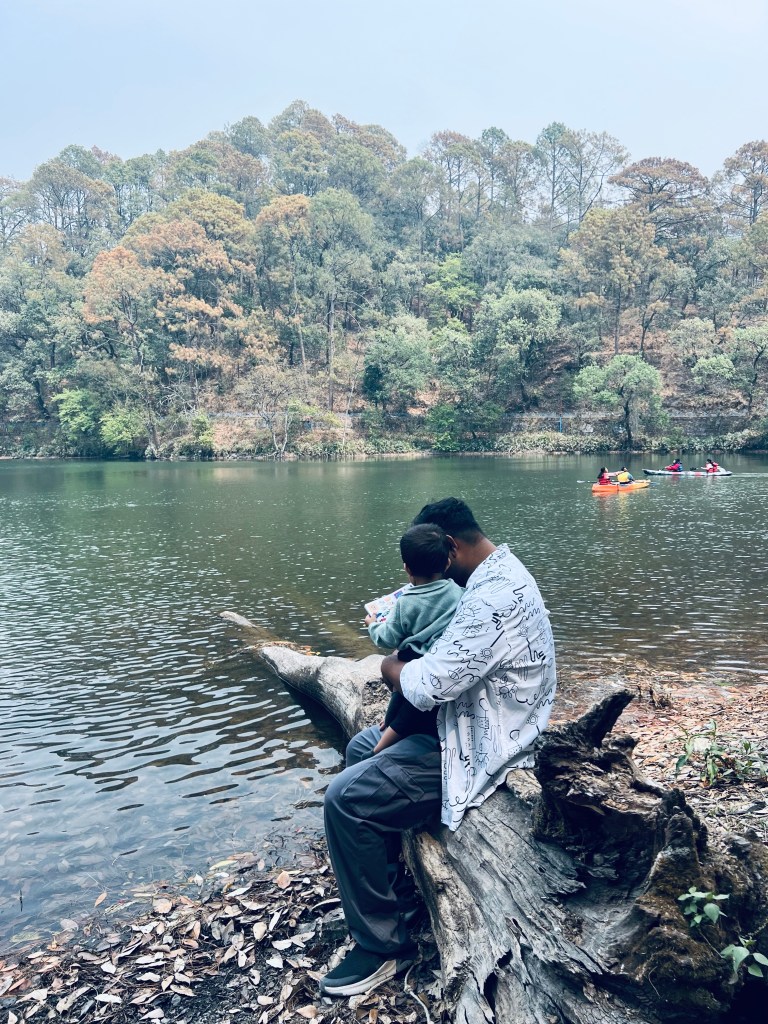
Watching the field for ten minutes without multitasking. Letting tea be just tea. Taking one drive with no agenda. Looking at flowers without photographing them. Sitting with my son without also carrying tomorrow in my head. Allowing one evening to remain unmonetized, unproductive, and unanswered.
These sound like small things. But maybe the soul survives on exactly such small things.
Maybe the person who will one day stand near that machan is being decided right now.
Maybe he is being built each time I refuse to reduce life to utility. Or maybe he is being destroyed each time I say, “Later, when things settle.”
The balcony and the machan are not merely two places. They are two states of being.
The balcony is height, pressure, perspective, ambition, management, distance. The machan is nearness, stillness, exposure, simplicity, and enoughness.
I need the balcony. It is where I have built, earned, struggled, and held together what must be held together. But I do not want to become a man who only knows how to live from balconies above life, overlooking it, organizing it, but never arriving inside it.
I want to still be able to descend.
I want that when the day comes whether it is in a field nearby, on a coastal road in India, on an evening in Amalfi, or in some ordinary hour I once would have ignored, I still have enough untouched self left to feel wonder.
The machan teaches me this from a distance: do not wait to finish life before you start inhabiting it.
Because one day, if I am not careful, I may finally have the time I begged for and become a stranger to the very peace I wanted.
We talk about it as if it is fixed, disciplined, almost respectable. Like some old headmaster with a watch in his hand. But honestly, time has a wicked sense of humor. It changes people quietly, and by the time you notice, the person, the feeling, the need, the relevance, everything has shifted.
A person moves through time and changes. That much is obvious. Priorities change. Ego changes. Dreams change. Even pain changes its clothes and starts introducing itself as maturity. Things that once felt like the end of the world later look like overacting with good lighting.
But the more fascinating thing is this: time also changes through the person living it.
One year can be nothing for one person and a complete lifetime for another. A waiting person knows this. A grieving person knows this. A person in love definitely knows this. Five minutes of silence from the right person can feel longer than a court matter after lunch.
That is why everything becomes relative. And relevance, even more so.
What matters deeply today may look laughably small tomorrow. What you once ignored may become the center of your life. What you once begged to keep, you may later thank God for losing. Time has this habit of exposing drama, polishing truth, and humiliating certainty.
And relationships, God, they are fragile in front of time.
Not always because people are bad. Sometimes just because time moves differently inside two people. One is holding on, the other is already elsewhere. One is building memory, the other is editing meaning. A relationship does not always break with betrayal or conflict. Sometimes it simply gets outlived by who the two people become.
That is the cruel part. And maybe also the honest part.
Some bonds survive time and become softer, deeper, more human. Others, despite all promises, cannot survive distance, silence, growth, ego, routine, or the thousand tiny changes no one notices while they are happening. Time rarely storms the door. Mostly, it just keeps knocking until the house feels different.
And then there is memory, time’s favorite prank.
We do not remember things as they were. We remember them as we have become. The same moment can feel like love, insult, lesson, or comedy depending on when life makes you revisit it. Time does not always change facts. It changes weight. It changes interpretation. It changes where the wound sits.
So yes, time is a funny concept.
It changes the person. The person changes the meaning of time. And between those two, everything we thought was permanent starts looking negotiable. Love, anger, relevance, certainty, even identity.
Maybe that is why wisdom comes late. Time makes sure of it. First it lets you speak with full confidence. Then it waits a few years and lets you hear yourself again.
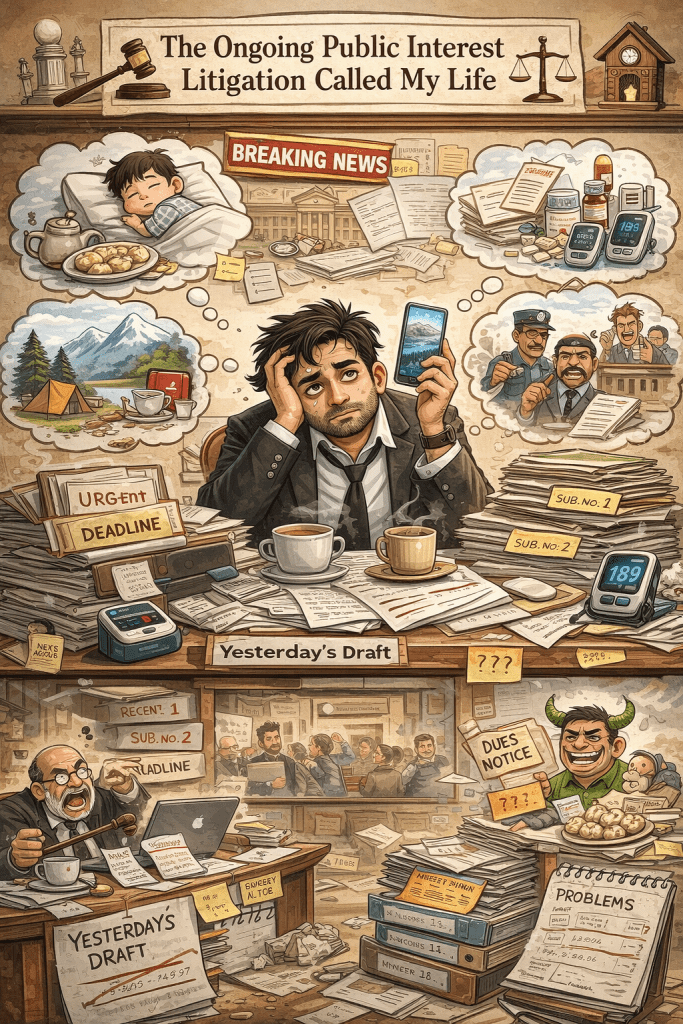
Lately I have started believing that my life should not be described as a routine. It should be described as a case status. Routine sounds far too stable, far too civilized, far too respectful of human limits. My life is not a routine. My life is listed, passed over, mentioned, restored, urgently circulated, partly heard, and then fixed for next date.
There are people whose mornings begin with yoga, sunlight, gratitude, and perhaps a calm cup of tea. My mornings begin with a negotiation between my soul, my sugar levels, my phone battery, and the accumulated nonsense of several fully grown adults who should have made better choices before involving me. By the time some people are choosing between oats and poha, I am already mentally preparing arguments, replying to messages, remembering which matter is in which court, locating one missing document, cursing one impossible litigant, and wondering if my own endocrine system has also filed a counterclaim against me.
I do not live one life anymore. I live a group litigation.
On paper I am a lawyer. Which sounds elegant, respectable, and intellectually refined. In practice, it means I spend a good part of my existence translating chaos into paragraphs. Somewhere, at any given hour, one client has discovered betrayal in a property transaction, another has discovered that cheques bounce more honestly than people, a third has suddenly remembered an important fact only after filing, and a fourth wants me to destroy the other side while also keeping things “amicable.” The Indian legal ecosystem runs on documentation, delay, drama, and a level of optimism that should be medically studied. And in the middle of this national theatre, I stand with a file, a pen, and the increasingly faint belief that justice and pagination can still coexist.
A normal person, after such a day, would come home and rest. But God, in His administrative wisdom, did not create me for normal. So after law comes family, parenting, planning, health, bills, social obligations, unresolved property irritation, occasional emotional collapse, and the permanent feeling that I am running a small republic whose departments are all understaffed.
Being an adult, I have learned, is largely about being interrupted while trying to solve another interruption.
There is no single theme to my life. It is a badly moderated panel discussion. One part of me wants professional excellence. One part wants financial stability. One part wants to be a present parent. One part wants to write novels full of longing and memory and unfinished love. One part wants to lose weight, regulate blood sugar, walk daily, and eat like a wise person. And one part, which I consider the purest and most evolved part, simply wants to sit in the mountains with tea and momos and never hear the words “urgent matter” again.
That mountain fantasy has now become less a travel preference and more a constitutional aspiration. I no longer dream of luxury in the way influencers do. I do not need a yacht. I do not need a wine estate. I do not want the French Riviera. I want a place where nobody says “Sir, just one small issue.” I want cold air, warm tea, and the radical freedom of not being cc’d on anything. I want to hear birds, not builder disputes. I want pine trees, not police inaction. I want clouds, not litigation strategy.
Unfortunately, I live in a reality where there is always one more application to draft.
The thing about being a lawyer is that people assume you understand conflict. This is wrong. I understand paperwork generated by conflict. The conflict itself remains as baffling as ever. Human beings continue to surprise me with their creativity in selfishness. Someone lies badly. Someone lies confidently. Someone lies in writing, which is a level of commitment one almost has to admire. Someone hides documents. Someone invents memories. Someone suddenly becomes emotional when facts fail. And I, like a public servant of suffering, must collect these fragments and present them before institutions that are also tired.
It would still be manageable if law were my only subplot. But my life has side quests with the ambition of main characters.
Health, for example, has become a full-time administrative department. There are medicines to remember, meals to manage, sugar readings to interpret, energy crashes to survive, and the daily comedy of trying to be disciplined in an Indian household where food is both love and sabotage. Every health plan begins with vision and ends with someone saying, “Ek din se kya hota hai?” This nation has delayed more diets with affection than disease ever could. I have learned that the body is a very sensitive institution. It reacts to food, stress, sleep, emotion, and the number of idiots one encounters before noon.
Then there is parenthood, which is perhaps the only department of life more exhausting and more beautiful than litigation. A child can reduce a grown adult to tears with one hug and destroy the same adult’s schedule with one sneeze. There is no procedural law in parenting. There is only improvisation, love, exhaustion, guilt, laughter, and the humbling realization that the small person you are trying to raise has greater emotional range than most fully briefed advocates. A client may lie to me. A judge may ignore me. A system may delay me. But a child asking for affection at the end of a terrible day can dismantle every cynical structure the world has built inside me.
And because madness apparently respects no professional boundary, I also write. Not just notes, applications, objections, notices, and arguments, but actual stories. Fiction. Novels. Emotions. Memory. Desire. Regret. Dark magic. Lost love. Human complexity. This means that after spending the day in the company of facts, I voluntarily go home and spend time with imagined people who are also troubled. Perhaps this is not creativity. Perhaps this is simply my mind refusing to accept a genre limit.
The great irony is that in court I am always searching for coherence. In writing I am searching for truth. In life I am searching for parking.
There are moments when I look at my phone and feel I am holding an archaeological site. Messages from clients. Messages from family. Court updates. Medical reminders. Half-written ideas. Screenshots of orders. Grocery concerns. Social media thoughts. Bank issues. Travel longing. Child matters. Random emotional debris. The average person has a life divided into categories. I have a WhatsApp that looks like the aftermath of a constitutional crisis.
And yet I continue. That is perhaps the most ridiculous thing of all. Not only do I continue, I continue with intent. I still want to do things well. I still want the draft to be stronger, the argument sharper, the family happier, the health steadier, the finances wiser, the story deeper, the future better. This is either admirable resilience or untreated delusion. At this point I am open to both interpretations.
I have come to suspect that competence is not a blessing. It is bait. The moment the world senses that you can handle things, it starts throwing extra things at you. Need a complex draft. Send it to him. Need someone to think clearly in a mess. Call him. Need emotional support with legal strategy and formatting suggestions. Definitely him. Need someone to be practical, composed, emotionally available, financially aware, medically disciplined, creatively alive, and spiritually stable. Why not one person. Why not me. Why not also before lunch.
There should be an award for people who remain functional despite never being allowed to finish one thought completely.
Sometimes I think my real superpower is not intelligence or drafting. It is recovery. The ability to go from irritation to usefulness. From chaos to structure. From disappointment to work mode. From stress to tenderness. From absurdity to another numbered paragraph. There is something deeply comic about a person spending one hour thinking about criminal procedure and the next thinking about whether he has had enough protein. This is the true modern professional identity. Not balance. Not mastery. Just rapid emotional switching with decent formatting.
If an outsider looked at my recent life updates, they might say I need rest. This is true. They might say I need boundaries. Also true. They might say I am doing too much. Obviously true. But they would miss the central fact. This is not just overload. This is devotion wearing the face of chaos. I care too much to become casual. That is the whole problem. I care about the case. I care about the outcome. I care about the family. I care about the sentence sounding right. I care about the future not collapsing under present carelessness. And caring, unfortunately, is not a peaceful hobby.
So here I am. Lawyer. Parent. Planner. Patient. Writer. Occasional philosopher. Full-time responder to unexpected developments. A man whose dreams involve mountains but whose days involve mentions. A man who wants simplicity but keeps choosing responsibility. A man who is trying, in his own messy way, to remain human while being useful.
This, then, is the latest update from my life. Nothing is under control, several things are pending, health requires supervision, the heart wants the hills, the files want attention, the child wants time, the body wants discipline, the mind wants escape, and the world keeps arriving with fresh paperwork.
In conclusion, I would like to state for the record that I am not exactly living life these days. I am conducting it like a prolonged hearing with intermittent emotional evidence. The matter is complex. The parties are many. The record is bulky. The issues are not framed. And adjournment, as always, is unlikely.
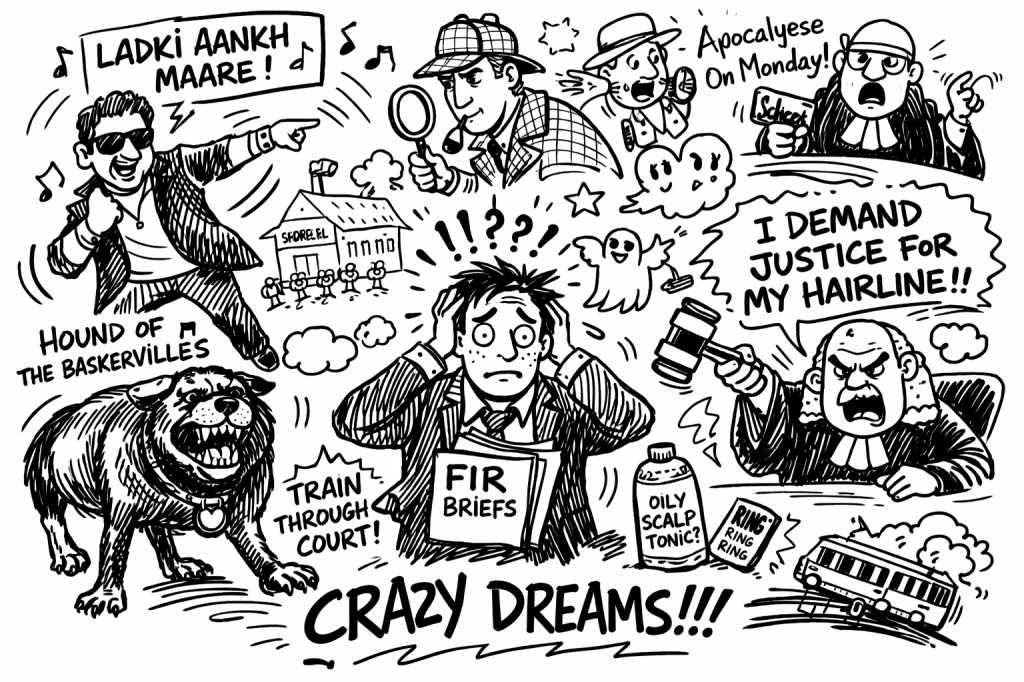
Not weird in a poetic moonlit lake sort of way. Not the kind of weird where a butterfly becomes your grandmother’s blessing and flies into a pastel sky. No. I mean the kind of weird where your subconscious looks at your already fragile mental condition and says, let us put on a full courtroom drama, add three item songs, one British detective novel, unresolved childhood shame, mild acidity, and see what happens.
My dreams are never normal. I do not get the luxury of dreaming that I am on a beach, financially secure, wearing linen, holding a book I am actually finishing. My dreams come with paperwork. My sleep has litigation. Somewhere in my REM cycle, a clerk is stamping things aggressively.
I am always anxious in dreams. Always on my toes. Always trying to solve something urgent and fundamentally absurd. One moment I am chasing the Hound of the Baskervilles through what appears to be old Noida mixed with Victorian England, and just when I am about to uncover the mystery, Arshad Warsi appears from nowhere, in full energy, dancing to Ladki Aankh Maare as if this is the most natural transition in the world.
And the worst part is that dream-me accepts it.
That is what concerns me.
There is no pause. No question. No intellectual resistance. My dreaming self never says, excuse me, what is Arshad Warsi doing in a Gothic murder investigation. No. Dream-me simply adjusts the collar, nods solemnly, and continues running as if this was all mentioned in the case diary.
Dreams have no respect for genre. They are lawless. They are the one place where tragedy, comedy, horror, Bollywood, paperwork, school trauma, old friendships, mythological references, and pending emotional damage all gather in a single municipal hall and start screaming over each other.
I have heard “order, order” in my sleep with more sincerity than I have heard in some actual rooms. In my dreams, judges are furious, but not about injustice, corruption, or the collapse of public morality. No. The judge is demanding justice for his receding hairline. He is personally wounded. He is looking at me with disappointment that stretches across generations. And I, an officer of this completely broken dream court, can offer him nothing except a gavel and perhaps some weak suggestions for oily scalp management.
That is the entire brief.
Not constitutional morality. Not equity. Not criminal liability. Hairline.
And yet in the dream it feels urgent. Nationally urgent. Historically urgent. Like if I fail to restore follicles to this man’s forehead, the republic itself will collapse by lunchtime.
This is what dreams do. They take your ordinary anxieties and dress them in circus clothes. You go to sleep with one manageable worry about work, money, family, health, or whether you said something awkward in 2018, and your brain turns it into a six-hour feature film where you are barefoot in a district court, your school principal is now the public prosecutor, your mother is driving a bus through a wormhole, and someone from your past is staring at you as if you have ruined their life by not replying to a text they never actually sent.
Dreams are not interested in coherence. Dreams are interested in atmosphere and emotional damage.
That is what makes them funny later and devastating in the moment.
Because while a part of me laughs at the sheer ridiculousness of it all, another part knows that dreams are built from scraps. They are stitched together from leftover fear. A worry about health becomes a collapsing staircase. A fear of failure becomes an exam hall. Guilt becomes a phone call you cannot answer. Grief becomes a house with one locked room. Stress becomes endless corridors. Responsibility becomes a child you are carrying through a crowd while everyone around you is either singing or setting something on fire.
And still, the dream insists it is all normal.
That may be the most insulting part of dreams. Their confidence.
In dreams, impossible things happen with bureaucratic calm. A tiger is sitting in your office chair. Fine. Your deceased relative is making tea in the kitchen. Understandable. Your old classmates are all judging your bank balance while a train passes through your living room. Of course. Somewhere a man with the face of your mathematics teacher is announcing that the apocalypse has been delayed till Monday due to administrative reasons.
And you just go with it.
Sleep is supposed to be rest. Whoever marketed it that way clearly never had an overactive mind. For some of us, sleep is unpaid overtime in a haunted department.
You do not sleep. You report for duty.
You close your eyes at night hoping for peace and your subconscious says wonderful, we have scheduled a crossover event. All your fears from the last fifteen years have arrived. They have name tags. They will now perform.
Sometimes I wonder whether dreams are the brain’s way of cleaning up. But if so, my brain is an extremely careless cleaner. It does not sort things gently. It picks up random emotional objects and throws them into one large bucket. A legal notice, one school memory, two episodes of panic, one old song, the face of a person you have not met in ten years, mild concern about hair fall, one historical author, a police siren, a childhood lane, and a vague feeling that you forgot something very important. Shake well. Serve at 3:17 a.m.
And then you wake up tired, as if you have not rested but testified.
There is also a peculiar loneliness to certain dreams. Even the funny ones carry a bruise. You wake up laughing at the absurdity, yes, but under the laughter there is often something softer and sadder. Why was I running so much. Why was I trying to fix everything. Why was I late. Why was everyone demanding something from me. Why did even the people in my dreams look like they expected me to solve what could not be solved.
That is when dreams stop being random entertainment and begin to feel like emotional audits.
No one admits this, but some dreams expose how tired you are. Not sleepy. Tired in the deeper way. Tired of holding everything together in waking life. Tired of appearing functional. Tired of being the person who must remember, answer, manage, explain, protect, provide, reassure, decide. In dreams, all that pressure returns wearing clown makeup.
So yes, it is funny that Arshad Warsi can suddenly appear in a gloomy detective chase and begin dancing with unearned confidence. But perhaps that is exactly how the mind copes. It knows that if it showed us our fears plainly, we would refuse to look. So it adds choreography. It inserts songs. It gives sorrow comic timing. It makes a spectacle out of strain so that we can survive seeing it.
Maybe that is why some of the saddest dreams are also the strangest. The heart cannot always speak directly. Sometimes it says, here is a judge angry about his hairline. Decode that yourself.
And we do.
Over morning tea, we sit with the wreckage and try to interpret it like underpaid philosophers. What did it mean that I was in school but also in court but also in a moving elevator in Budaun while someone played dhol in the background. Was it stress. Was it memory. Was it symbolism. Was it indigestion. The answer, most likely, is yes.
Dreams are ridiculous. They are theatre produced by panic and nostalgia. They are badly funded, poorly edited, emotionally ambitious projects. They make no sense and too much sense. They leave us amused, embarrassed, unsettled, exposed.
And still every night we return.
Because somewhere beneath all the chaos, the absurd juxtapositions, the strange casting choices, the dramatic background score, the impossible architecture, and the deeply unhelpful symbolism, dreams are trying in their own unhinged way to tell us something.
Maybe that we are overwhelmed.
Maybe that we miss people more than we admit.
Maybe that our minds are cluttered attics full of unfinished thoughts.
Maybe that fear itself is a storyteller.
Or maybe dreams are just the brain’s nightly open mic and we are unlucky enough to be seated in the front row.
Either way, if tonight I find myself once again in some semi colonial courtroom where Sherlock Holmes is filing a maintenance petition, a band is playing remixes in the corridor, my brief has turned into an FIR, and a deeply offended judge wants equitable relief for his receding hairline, I will do what any dignified adult would do.
I will stand up, adjust my invisible band, and say, with whatever courage remains in my sleeping soul, “My lord, on instructions, I seek a short pass over.”
A boy sitting peacefully, eating his pohe. Nothing dramatic. No background music. No life lesson being preached. Just a child enjoying his food with complete sincerity.
The caption read, “Peace of not knowing everything.”
What stayed with me was not the food. It was the expression on his face. Pure contentment. No hurry. No calculation. No silent mental noise.
Scrolling through the comments felt strangely personal. People kept saying they did not know when they lost that peace. And that hit hard, because most of us truly do not remember the moment it disappeared. It was not taken from us overnight. It slowly slipped away while we were growing up.
As children, hunger meant hunger. You ate when you were hungry. You slept when you were sleepy. Life did not come with options, comparisons, or self doubt.
Now even eating requires a committee meeting. Is this healthy. Is this allowed. Is this too much. Is this too late. Should I compensate tomorrow. The pohe is still the same, but the mind eating it is exhausted.
The boy in the video did not know about deadlines, disappointments, red flags, emotional intelligence, financial planning or healing journeys. He also did not know how things end before they even begin.
And yet, there he was. Completely present.
Somewhere along the way, we started knowing too much. We learned to anticipate pain. To analyse happiness. To measure moments instead of living them. We did not lose peace because life became difficult. We lost it because our minds never learned to rest.
I do not want to go back to childhood. But I do miss that version of living where a simple moment did not need justification.
Maybe peace is not about having everything sorted.
Maybe peace is just eating your pohe without wondering what it means.
Sit by the Ganga long enough and you’ll feel it. The river flows endlessly.
You sit silently. And suddenly your mind whispers “We are nothing. Temporary travelers.Our fights, ambitions, relationships, achievements are all pointless.”
You nod slowly, pretending you didn’t just think about quitting your job and becoming a minimalist.
People nearby assume you’ve reached enlightenment. Because apparently, location matters more than logic.
Now imagine the same thought arriving elsewhere.
You’re sitting on the commode.
Door locked.
Phone in hand.
Life paused.
And the exact same realization hits:
“Everything is useless.”
But this time there’s no river.
No breeze.
No chanting.
Only an exhaust fan screaming like it regrets being born. Suddenly, it’s not spirituality anymore. It’s “bro, are you okay?”
At the ghat, this thought is called awakening. In the bathroom, it’s called depression with Wi-Fi.
Funny thing is that the thought doesn’t change. Only the aesthetics do.
The universe doesn’t care where you sit. It sends truth wherever you’re most defenseless.
Ganga gives you poetry.
The toilet gives you honesty.
At the river, your ego dissolves slowly. In the bathroom, it collapses violently. There, stripped of dignity and social performance, you don’t feel divine. You feel replaceable.
Your career? Optional.
Your anger? Meaningless.
Your enemies? Probably asleep.
Your legacy? One forgotten password away from deletion.
That’s when it hits hardest. Not “we are part of something bigger.” But:
“No one is keeping score.” And that’s terrifying. Because if nothing really matters… then all the stress you carry every day was self-inflicted.
We romanticize suffering only when it looks aesthetic.
Pain with sunlight = philosophy.
Pain with tiles = mental breakdown.
Yet both reveal the same truth. You don’t need holy water to feel small. Sometimes a bad stomach is enough.
Turns out, enlightenment doesn’t come from the Ganga, it comes when even your ego can’t survive the flush.
This weekend, read today, I went to the Kukdukoo Fest with two toddlers.
One is my son, who turns three in a week. The other is my niece, who turned five last September which basically makes her the senior citizen of the toddler delegation.
The moment we entered, I realised something was off. Not with the kids.
With us.
Because everywhere I looked, there were tired children… and even more tired parents pretending they were “having a family moment.”
You know the look. The fake smile. The one that says: “Yes, I paid for this.”
The stage had artists performing, unfamiliar artists. Very unfamiliar. So unfamiliar that even Google would’ve said, “Did you mean… someone else?”
The kids didn’t care. They were busy running toward balloons, bubbles, and chaos.
We, the parents, stood there clapping politely, wondering whether this was a concert or a school annual function sponsored by capitalism.
And then came the stalls. Ah, the stalls.
Every single one decorated beautifully to gently and lovingly just put a hole in your pocket.
₹450 for popcorn.
₹600 for something that looked like cotton candy but tasted like regret.
₹1,200 for a toy that would be broken before we reached the parking.
At some point, I saw a Comic Corner.
Instant nostalgia hit.
I picked up two comics the kind I used to read lying on the floor, ignoring homework and life responsibilities.
For a moment, I smiled. Then I realised something terrifying. It didn’t feel the same. Not because the comics were bad but because I wasn’t ten anymore.
I wasn’t reading them to escape homework. I was reading them while mentally calculating school fees, nap schedules, and whether the kids had eaten enough protein.
That’s when it hit me.
Remember when we used to go to concerts? We’d come back exhausted.
Sweaty. Smelling like someone had secretly puked on us. But we called that great times. Now we come back exhausted, sweaty, smelling like milk, snacks, and emotional burnout and we call it “family outing.” The kids slept in the car. Peaceful. Angelic.
The parents? Silent.
As I sat there, holding my comics, watching my son drool in sleep and my niece clutch a free goodie bag like she’d fought a war for it, I realised: Somewhere between childhood concerts and toddler festivals… we didn’t grow up. We just got upgraded responsibilities.
Ahh. The pangs of old times. May I find peace.…preferably somewhere quiet. With no stage. No stalls. And absolutely no popcorn costing ₹450.
Not because of monsters or the Upside Down. But because it feels like childhood. The kind you do not realize you are losing until it is already gone.
Dustin is my favorite. Always has been. He feels real. He is brave without trying. Funny without forcing it. Loyal in a way only children are. When you see Dustin, you remember how friendships once felt effortless. No filters. No calculations. Just showing up.
The second half of the finale is pure emotional gold. Everything slows down. The noise fades. What remains are feelings. The kind you sit with quietly. The kind that do not ask for attention but stay long after the screen goes dark.
Watching Mike write at the end broke something in me. Writing what he could not say. Narrating what he could not fix. Sometimes words come easier on paper. Sometimes that is the only way we survive change.
And then that moment. Mike seeing Holly play D and D.
That was not just a scene. That was time folding in on itself. Childhood passing hands without ceremony. One generation stepping out while another steps in. No goodbyes. No announcements. Just a quiet understanding.
When the door shut at the end, it felt personal.
It reminded me of school friends. College friends. People who once meant everything. People I laughed with every day. People I thought would always be there. Now they feel like they are behind closed doors. Not gone. Just unreachable.
You know they exist. You know they are happy somewhere. But you cannot walk back in. Life does not let you.
Stranger Things hurts because growing up hurts. It is not loud. It is silent. It happens between moments. Between episodes. Between years you do not count.
The show does not say goodbye properly. And neither does life.
It made me think of Life of Pi. About how the most important goodbyes do not come with words. No hugging. No final look back. One day someone is with you. The next day they are not. And you never realize that was the last time you would see them.
Stranger Things ends the same way.
No dramatic farewell. Just a door closing. And you standing there. Realizing you have already said goodbye.
Every new year arrives with the confidence of a motivational speaker and leaves like a distant relative who promised to help but “got busy.” Vision Board 2026 is no different. The only real upgrade this time is emotional maturity. Which, in Indian terms, means carrying all your old trauma into the new year but with less guilt.
Earlier, trauma came with shame. Now it comes with context. You don’t say “I messed up.” You say “I was surviving.” You don’t say “I made bad choices.” You say “Generational patterns.” Therapy language has given us the gift of accountability without accountability. Same wounds, better vocabulary.
The vision board says “healing.” Reality says “same issues, different excuses.”
Indian procrastination deserves its own place on the board. Not as a flaw, but as a lifestyle. We don’t delay work. We marinate it. We let it rest. We believe deadlines are suggestions and pressure is for pressure cookers, not humans. January is for planning. February is for recovering from January. March is when the year actually starts. By April, you’re tired. By May, you’re busy. By June, it’s too hot to grow as a person. July onwards, you’re emotionally preparing for next year.
Consistency is promised annually and broken weekly.
Desi family problems, of course, get their own corner on the vision board. You want peace. Your family wants updates. You want boundaries. They want explanations. You want growth. They want marriage. Or a child. Or another child. Or a better job. Or someone else’s child as a comparison chart.
Every family gathering feels like a performance review where no one knows your job description but everyone is disappointed.
Then come the New Year goggles. The stupidest tradition of them all. Who decided that numbers should sit on your face like a failed geometry experiment? 2026 is especially cruel. No symmetry. No aesthetic balance. Too many straight lines. Not enough circles. Designers struggle because how do you make “2” look festive without it resembling a broken hanger? How do you celebrate a year whose digits refuse to cooperate?
Some years are just not photogenic. 2026 is one of them.
And yet, we will still make the vision board. We will paste words like “discipline,” “abundance,” and “calm.” We will screenshot quotes we won’t read again. We will save reels about morning routines we won’t follow. We will promise ourselves things we couldn’t keep last year but will confidently promise again.
Because hope, in India, is not optimism. It’s tradition.
Vision Board 2026 is not about becoming a new person. It’s about becoming slightly more self-aware while staying exactly the same. Same trauma. Same procrastination. Same family WhatsApp groups. Just better captions and lower expectations.