This is not a joke. I have genuinely broken my left arm. Not metaphorically. Not emotionally. Proper orthopedic level damage. Plaster. Sling. Sympathy from strangers. And suddenly, the universe decided that this was the correct moment to unleash winter.
The temperature dipped immediately. Coincidence? I think not. The weather clearly saw my cast and said, perfect. Now let us add craving.
I am craving steaming hot momos. Not politely warm momos. I want them to go directly into my mouth so that I can make those completely undignified vhuavhuavhua sounds while trying not to burn my tongue and still refusing to let the momo go. The kind of sound that tells the momo, you will hurt me, but you will not escape.
Then there are those crispy brown aloo tikkis. The ones whose tawa gives off heat strong enough to restore faith in humanity. You stand near it pretending to decide whether you want chutney or not, but actually you are just borrowing warmth. The chole follows. Garam. Spicy. Mischievous. Playing table tennis with your tongue while you pretend you can handle it.
December cold waves are not weather. They are emotional manipulators. They whisper things like eat something fried, eat something hot, you deserve this, look at your arm. And honestly, after a week of this, I believe them.
At this point, my left arm is broken but my willpower is fully intact only when it comes to ordering food. I should have bought an automatic. Because managing winter, injury, and self control simultaneously feels like a manual transmission on a steep hill.
I love winters. I truly do. The clothes are better. The food is superior. The excuses are endless. And after thoroughly enjoying all these thoughts for a solid week, I have arrived at a very mature decision.
I never know how much I’m going to earn in a month. Some months feel like God personally handled my billing. Some months feel like I’m on God’s blocked list.
Being an advocate does that to you.
You never really “make money.” You just occasionally receive it.
And those who say, “but you’re your own boss,” have clearly never waited for a client who says, “Sir, amount transfer kar raha hoon abhi.”
I had always seen people getting salaries. Same date. Same SMS. Predictable. Peaceful. And here I am, part of the urban poor who are still trying to understand how cash flow is managed, mismanaged, and completely dependent on mood.
Feelings, it turns out, are the worst financial advisors. When you’re in a good mood, you treat yourself like Ambani.
When you’re anxious, you start calculating GST on samosas.
But if you ever feel lost, just remember what Iliaas Bhai said in Aankhen (2002), “किस्मत पे रोने का नहीं, कैलेंडर बदलते रहने का.”
That line has more financial wisdom than half the self-help books in the world.
Every time a case doesn’t convert or a client ghosts me after saying “will call you tomorrow,” I repeat it like a mantra.
It’s my monthly reset button.
When rent is due, and nothing is due to you, change the calendar.
When you open your wallet and it sighs back at you, change the calendar.
When you start believing the next month will be better, congratulations, you’re financially stable in spirit.
This profession has taught me that luck doesn’t arrive with notice, and payments don’t either.
So stop crying over fate. Tear the old page.
Start the next month.
Because sometimes, the only difference between despair and hope is a new date printed on paper.
You know what happens on September 1? Wizards who have turned eleven board the Hogwarts Express for the very first time. For most Potterheads, that date lives like a bookmark in memory, the promise of a beginning, of adventure, of leaving the ordinary world behind.
For me, September 1 is more than just a line on the calendar. It’s a reminder of how Harry Potter grew alongside me, how my elder brother became my companion through the magic, and how those books turned into a mirror of my own growing years.
My Hogwarts Express didn’t leave from King’s Cross. It began in the form of books passed down by my brother. I didn’t have a circle of friends to huddle with over theories or heated debates. Instead, I had one person. my elder brother.
I would passionately rattle off my thoughts, predictions, and bewildering theories, while he, with infinite patience, listened. He humored my nonsense, and in doing so, gave me something precious — the feeling that my excitement mattered. That was my own ticket through the barrier.
Some memories of that era are etched into me with unusual clarity. I still remember begging my brother to take me to watch Order of the Phoenix again even though I was terribly sick with jaundice. Nauseated and weak, I should have been in bed. But magic doesn’t wait for fevers to subside.
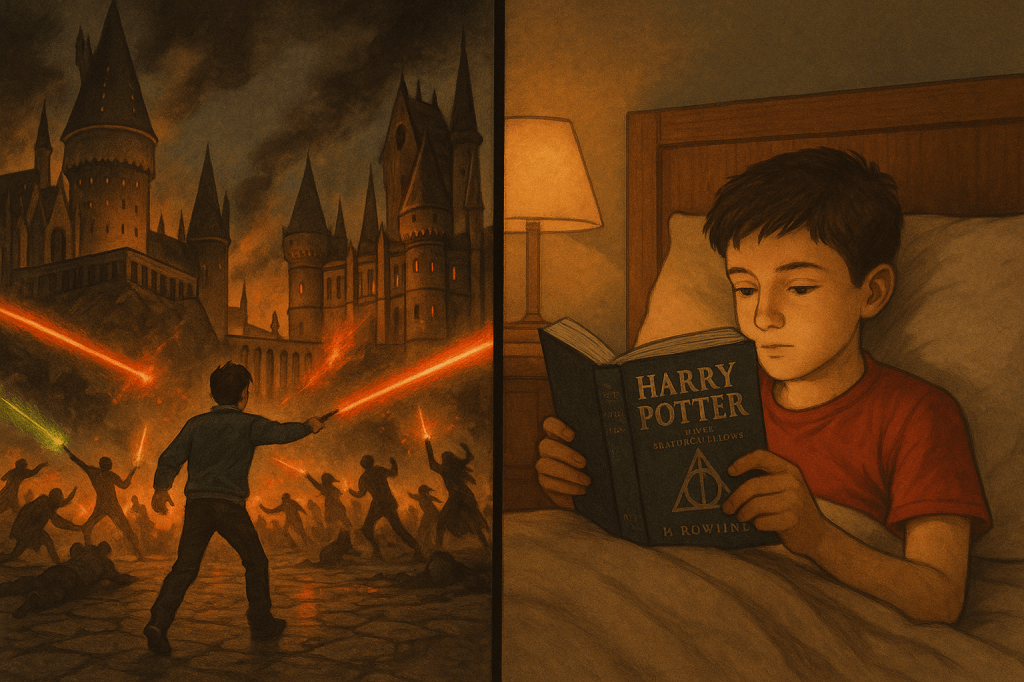
Just two weeks later, Deathly Hallows released. This time, I was back in bed, still recovering. But the book itself became my medicine. I devoured it cover to cover, fever and all.
By the time Deathly Hallows landed in my hands, I was in my final year of school. Academically, later in that academic year, things didn’t go as well as I had hoped. I didn’t close that chapter of my life with shining marks or accolades. But strangely, the real sense of closure didn’t come from my exams anyway it came from those final pages.
Harry’s battles, his losses, his choices mirrored the struggles of growing up. For me, he wasn’t just a character. He was an alter ego, carrying lessons of resilience, courage, and belonging.
Even in college, Harry followed me. I remember going to see Delhi 6 with my mates. When Amitabh Bachchan and Abhishek Bachchan appeared on screen in that surreal conversation at terrace of Chandani Chowk house, I whispered excitedly, “That’s Albus and Harry talking at King’s Cross!” My friends stared blankly, they couldn’t comprehend what I meant, because the last book hadn’t been adapted yet.
It was one of those moments where fiction spilled out of the pages and into real life, but only I could see it.
The final two films I watched with my girlfriend who would later become my wife. She sat beside me, enjoying the spectacle, but couldn’t quite understand why the New Beginning Theme made me cry. For her, it was just music. For me, it was years of growing up, of farewells, of a chapter closing. Tears rolled down, and I couldn’t even explain it then.
When I turned the last page of Deathly Hallows, it felt like finishing a chapter of my own life. The books had grown with me, year after year, and suddenly, the journey was complete.
But nostalgia is stubborn. It doesn’t let go easily.
And now, the story doesn’t just belong to me anymore. I feel a heavy yet beautiful duty, to pass it on. I can’t wait to hand these amazingly illustrated Harry Potter books to my son when he finally learns the difference between tearing a book apart and truly reading one.
P.S. People sometimes give me that “are you serious?” look when I say “Hogwarts feels like home.” I get it, to them, it’s just fiction. Meanwhile, my friends still pump their fists at “Bring me Thanos!” But honestly? Harry walking back into Hogwarts will always give me bigger goosebumps than a giant purple villain and a Norse god with a hammer combined. If that makes me sound crazy, fine. I’ll proudly be that weird guy who treats September 1 like a holiday. After all, there are far worse places to call home than Hogwarts.
I never felt the same way about life after I held my son for the first time in 2023. Since then, everything has shifted family, relationships, priorities, and the strange amount of space occupied in my phone gallery by one very small human.
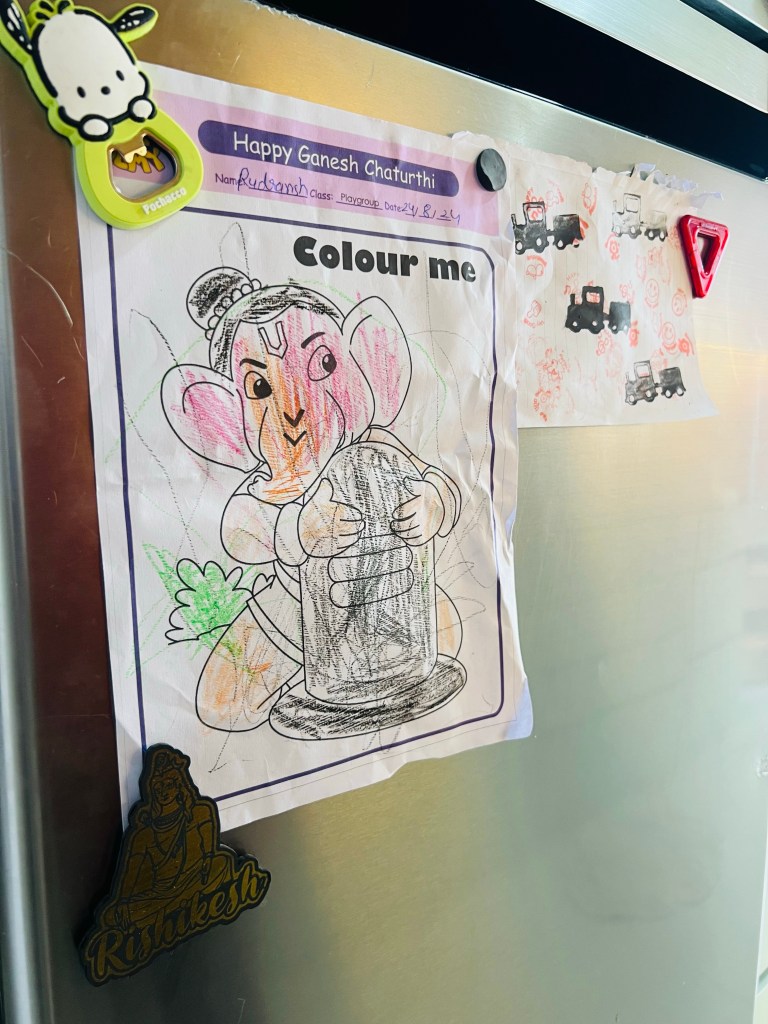
Now, at 32 months old, my son has evolved into what I like to call “a negotiator with diapers.” He doesn’t just ask for chocolate he structures his demands like a lawyer: “One more piece, then sleep. Promise.” If he had a LinkedIn, his headline would read: “Specialist in Snack-Based Diplomacy.”
I keep track of his every move like a CBI officer on a high-profile sting. Where he is, what he’s doing, which object he’s trying to dismantle, it’s all in my mental database. But then came the shocking reality check: the outside world doesn’t see him as special.
At his playgroup, he’s just another toddler. One of twenty sticky-fingered, glue-eating, block-throwing kids. No teacher whispers, “Here comes the prodigy.” They just shout, “Beta, sit down.” Honestly, it crushed me. I half expected him to be crowned “Toddler-in-Chief” by now.
That’s when it hit me, maybe it’s not the world that’s wrong. Maybe it’s me. Because the responsibility of shaping him into a decent man feels like it’s sitting squarely on my shoulders. And let’s be honest: I’m just a guy who believes no other child negotiates bedtime quite like mine.
Every parent thinks their kid is Shakespeare in training or Einstein with a Peppa Pig lunchbox. Reality check? Society doesn’t care. To them, our kids are crayons and biscuits, not Nobel laureates in diapers. And maybe that’s okay.
I’ve realized I’m not running a factory where I mold him into perfection. I’m running a garden. My job is to water, prune, protect from weeds (aka bad influences and excessive sugar), and let him grow in his own quirky, unpredictable way.
If I do my part right, maybe he’ll grow into a man who: Reads people well, because his snack-negotiating skills were sharpened at home. Feels secure, because he was always truly seen, even when the world overlooked him. Learns to adapt, because he’s practiced both blending in and standing out. And if nothing else, he’ll at least become the man who taught his dad patience.
So here’s the truth: my son is both the most extraordinary negotiator I’ve ever met and just another kid in the playgroup crying outside to go back home with his mother. And maybe that balance, “special at home, ordinary in the world” is exactly how it should be.
And who knows? If he ever runs for Prime Minister someday, remember it all started with icecream negotiations at bedtime.
Let’s talk about wisdom. Not the kind etched into temple walls or whispered by monks on mountaintops. I’m talking about the real, gritty, painfully accurate wisdom that usually shows up after you’ve eaten too much chilli or replied “sure, let’s catch up” to someone who drains your soul.
This kind of wisdom doesn’t glow. It doesn’t trend. It isn’t curated by an influencer in Bali sipping green juice on a bean bag. It’s the annoying voice in your head — the one that says, “You know this is a bad idea, right?” And we, being human and tragically optimistic, go ahead and do it anyway.
Chapter One: That Inner Voice We Treat Like Spam
Every time you’re about to do something dumb, like buy a juicer to ‘start fresh’ even though you’ve never juiced anything in your life, there’s a voice. A small one. Kind of like the mental version of your mom clearing her throat behind you.
It says, “Are you sure?” And you say, “Let me live!”
That voice has been honed by generations of human stupidity. It’s survived wars, heartbreak, and Black Friday sales. But now, its job has been taken over by… algorithms.
Chapter Two: Algorithm Gurus and Their Unshakable Faith
Enter the modern breed of wisdom, the people who are 110% convinced that their algorithm knows them better than their mother, therapist, or bank account.
These are the folks who say things like “The Universe sent me this Reel and I just knew I had to break up with him.”
Or, “My feed is so aligned right now. It’s like, healing.”
They follow accounts that post pastel quotes like, “You are the sun, babe. Burn for no one,” and then proceed to ignore their credit card bill and text someone named Karan at 2:17 AM.
They believe the universe is speaking through TikTok. They get their nutritional advice from astrology memes and use phrases like “retrograde made me do it” while eating nothing but air-fried zucchini chips.
And here’s the kicker, they are so sure. So absolutely confident that their algorithm, their curated bubble of content and confirmation bias, is smarter than centuries of lived human experience. They think they’ve cracked life, love, parenting, finance, and digestion. Meanwhile, the rest of us are quietly Googling, “Can one die from excessive emotional intelligence?”
Chapter Three: The Chilli, the Mistake, the Lesson
Despite all this algorithmic enlightenment, some wisdom never changes. Like the lesson that too much chilli will eventually humble you, no matter how spiritual or gluten-free your diet is.
You can follow all the gut health influencers in the world. You can watch thirty-seven Reels about the benefits of cumin water. But if you eat that extra-spicy paneer tikka because your ego said, “You’re built different,” you will still find yourself holding onto the sink for dear life the next morning, whispering, “Why me, God?”
That, my friend, is when real wisdom shows up. And it’s not in the form of a life coach in Ibiza. It’s your colon saying, “I told you so.”
Chapter Four: The Comeback of Common Sense
After a certain age, usually somewhere between your first heartbreak and your third probiotic… you start hearing the truth again. Not from an algorithm. But from within. The wisdom that says, “Drink water,” “Don’t text him,” and “You don’t need another plant.”
You realize that wisdom isn’t supposed to be sexy or viral. It’s supposed to be useful. Quiet. Annoying. Inconvenient. And deeply, unfailingly true.
It reminds you that kids don’t need martyrs for parents, they need emotionally stable adults. That staying in a relationship out of guilt is like keeping spoiled milk in the fridge “just in case.” And that sometimes, self-care isn’t a face mask. It’s saying no, sleeping early, and unfollowing that one person who makes you feel like you’re failing at life.
Final Thoughts: It’s Okay to Be Dumb (Just Don’t Make It a Habit)
We all have our moments of brilliance and our seasons of idiocy. That’s what being human is. The goal isn’t to be perfectly wise. It’s to be less stupid next time. To recognize when your gut is right, even if your Instagram Explore page is screaming otherwise.
So yes, follow your heart. But maybe cross-check it with your liver. Eat the chilli, but keep some curd nearby. Trust your algorithm, but also remember it thought you were into dog grooming videos for three months because you accidentally watched one pomererian being shampooed.
And when that ancient, boring voice in your head speaks up again? Pause. Breathe. Maybe listen this time.
Because the real wisdom? It’s not trending. But it’s waiting for you. Usually with a glass of jeera water and a slightly judgmental smile.
We often think of memories as gentle things, sepia-toned moments neatly folded in the drawers of the mind. But sometimes, memories bite.
Dante said it best, “There is no greater sorrow than to recall a happy time in misery.” It’s not the pain itself that aches the most, it’s the echo of joy that came before it. A laugh that once rang like music now sounds like mockery. A smile, once comfort, now a ghost.
Change is strange that way. It comes quietly at first maybe disguised as a missed call, a forgotten birthday, a difference in tone , until one day you realize that what was once familiar has become foreign. You stand at the edge of what used to be your world and it doesn’t recognize you anymore.
But here’s the truth no one likes to admit:
Change is not betrayal. Change is just change.
We tend to hold people to the last version of themselves we loved. We expect the friend who once understood every silence to always be that way. The lover who once reached out first to always stay. But people are rivers, not statues. They twist, split, dry up, flood and so do we.
Time doesn’t ask permission.
Even the deepest bonds, no matter how heartfelt, are still mortal. Some grow with us. Others don’t.
We grieve that and we call it loss.
But really, it’s just that life continues on without our consent.
And so, when we sit alone, aching for the echo of a laughter that no longer visits us, when we replay old conversations in our heads like a broken record, we must also remind ourselves: That version of you, the one who laughed in that moment, loved with that heart, believed in that future, still exists. And that matters.
It matters even if the people in that memory have walked away.
Even if you no longer recognize the one who smiled back in that old photo.
Because memory is not always there to heal. Sometimes it comes to teach.
That’s what I’ve been told. In history books. In dinner-table lectures. And perhaps, even in some previous life, I was the vendor handing out a paper cone full of Jhalmuri to a Portuguese man who didn’t know what hit his palate.
You see, while others traded pepper, cardamom, or cinnamon, I, true to my entrepreneurial spirit was probably the guy saying, “Bhaisaab, le lo ekdum chatpata Jhalmuri! Masala extra, emotion free.”
Somewhere, I feel, that’s still who I am.
What is so great about Jhalmuri?
Everything and nothing.
It’s puffed rice, onions, mustard oil, green chillies, peanuts, some bhujia, coriander, tomatoes if you’re fancy, and lemon juice that tastes better when squeezed with existential dread. There is no recipe only instinct. No proportion only impulse. No balance, just chaos in a cone.
And it tastes divine.
My life, lately, has become Jhalmuri.
Too much chilli in the wrong place. Too little crunch. A lot of mustard oil floating on top, trying to pretend it’s holding things together. Every now and then, a surprise bite hits you, hard peanut, burnt rice, or something spicy that shouldn’t be legal.
It’s unstructured, imbalanced, overwhelming, and yet somehow… I keep munching.
People ask, “What’s going on?”
I say, “Life is Jhalmuri, boss.”
You may wonder, what do Europeans have to do with all this?
Absolutely nothing.
But I needed someone to blame. The British took Kohinoor, and I’m taking poetic license. It’s only fair. The bigger question is if we all sold our spices for silk and silver, what did we keep for ourselves?
My answer: Jhalmuri.
Unpackaged. Unbranded. Untamed.
Because when the world feels too much when plans crumble, routines dissolve, and people surprise you with their odd mix of sweetness and spice I don’t crave order. I crave Jhalmuri.
Maybe, just maybe:
Life is not meant to be a neatly plated continental course. It’s meant to be a roadside snack. Messy. Spontaneous. Eaten standing up while dodging traffic, opinions, and one’s own expectations.
So here’s to Jhalmuri.
May your life be as unapologetically unpredictable, mildly crunchy, and beautifully imbalanced.
There’s a strange thing about victories. You wait for them. You prepare for them. You put your blood, your time, and your breath into chasing them. And then, when you finally hold them in your hand, they’re not quite what you expected.
As I sit down to write this, the thought is still forming. It’s not quite an article, not quite a diary entry—maybe just a mirror I’m holding up to myself. Maybe by the end of it, I’ll find an answer. Or maybe I won’t.
There was a time when I believed that the highest high I could ever feel would be clearing a competitive exam and becoming a judge. That image had become a kind of religion for me—waking up before the world, wrestling with law books, and imagining the day I’d be addressed as Your Honour.
Then I fell in love. Thought marriage would be the peak. I had someone in mind, someone from my college days. The story made sense in my head—two people who’d grown, evolved, and eventually found their way back to each other. That would be my “happily ever after.”
Then I held my newborn son in my arms. Life changed in that moment. His tiny heartbeat against my chest made me feel like everything had a reason. Surely, this was the ultimate high?
Turns out, life doesn’t work on a linear path of escalating highs. It isn’t a mountain with one glorious summit after another. It’s more like waves. They rise, they crash, they recede. And sometimes, you’re just floating, not knowing if the next wave will lift you or drown you.
Today was one of those “high” days. Four civil suits filed. Four injunctions granted. Everything went by the book. Sharp. Clean. Perfectly executed. I should’ve felt like a warrior coming back from battle. And for a moment—I did.
Then I sat in my car.
And just like that, a strange silence fell over me. The kind of silence that isn’t peaceful but empty. The kind that swallows applause, ambition, and even pride.
Suddenly, it felt like nothing mattered.
I don’t mean that in a cynical way. I wasn’t sad. I wasn’t depressed. I was just… still.
And in that stillness, a truth emerged.
The real difference today wasn’t made by me.
It was made by that judge.
Not just a person occupying a chair, but someone who truly deserved to be there. Someone who understood the essence of justice—not just its letters, but its spirit.
It hit me then—maybe there’s no grand purpose or inferior purpose. Maybe purpose isn’t something to find or chase. Maybe it’s just… doing your job. Honestly. Consistently. Quietly.
Maybe the only real thing in this profession, or perhaps in life, is the integrity with which you show up each day. That’s it. No music. No medals.
Sometimes, I joke to myself—maybe I should leave it all behind and become a hermit. Just disappear into the woods with a few books, a warm blanket, and silence.
But even that is probably just another high I’m dreaming of. Another summit in disguise.
For now, I’ll return to work. I’ll keep filing, keep arguing, keep hoping. And maybe, once in a while, I’ll write.
Because maybe, just maybe, there’s some purpose in that too.
Have you noticed how social media has turned us into masters of brevity? It’s like we’re all trying to explain quantum physics while being chased by a bear – fast, panicky, and missing a few key details. Thanks to reels, shorts, and TikToks, we’ve achieved what centuries of philosophers couldn’t: summing up the meaning of life in under 30 seconds, often with a Bollywood remix playing in the background.
Take emotions, for example. Back in the day, heartbreak meant writing poetry by candlelight, wearing all black, and staring longingly out of the window until your neighbors started asking questions. Now? A 15-second reel with captions like “Me: I’ll never love again. Also me: 💃” does the job. If Romeo and Juliet had Instagram, they wouldn’t need three acts of tragic build-up. Romeo would’ve just slid into Juliet’s DMs with, “u up?” She’d post a sad reel with a Arjit Singh song after drinking poison. The end.
And let’s talk about dance. Remember when learning a new dance meant weeks of practice, awkwardly tripping over yourself, and eventually just giving up and swaying side to side? Not anymore! Now, choreography is boiled down to 3 seconds of arm flailing, a hip thrust, and an ending pose that makes you look like you just got electrocuted. Miss a step? Don’t worry, nobody will notice—they’re too busy wondering why you’re dancing in your kitchen wearing a bathrobe.
But the real MVPs of this short-attention-span era are life philosophies. People are now condensing decades of wisdom into a single sentence plastered over stock footage of waves. “Be the wave, not the sand.” What does it mean? Who cares—it got 2 million views. Aristotle spent years pondering the meaning of existence, but today’s sages just need Canva and a motivational quote generator.
The beauty (and chaos) of this 30-second world is that it leaves no room for complexity. Everything is either the best day of your life or a complete disaster. You’re either slaying or failing. There’s no middle ground anymore—no “meh” days, no “I’m just surviving on caffeine and hope” moods.
And yet, amidst the oversimplification, there’s something strangely magical about it all. Social media’s obsession with brevity has taught us to laugh at our pain, dance like nobody’s watching (even though everyone is watching), and find joy in the ridiculous. Sure, we’ve lost nuance, but we’ve gained memes. And who needs Aristotle when you have a cat doing a perfect backflip?
So here’s to life in 30 seconds—where your deepest existential crisis can be set to EDM, and your greatest triumph is a slow-mo jump in the air. Is it shallow? Maybe. But hey, at least it’s entertaining.
And if you don’t like this blog? Don’t worry, it only took you 30 seconds to read it.
Mondays, the universally dreaded day of the week, often come with a lingering fatigue from the weekend and a fleeting promise to take things easy. This Monday was no different. As I stumbled out of bed, trying to shake off the remnants of sleep, I made a mental note to keep things simple. Little did I know, the universe had other plans.
By midday, I was greeted not by a mundane workday, but by a virus. It crept up on me stealthily, taking my heavy meat suit down with it. My nose was blocked, my throat felt choked, and a heavy fever set in, making every movement a struggle. As I lay in bed, overwhelmed by the symptoms, a question loomed large in my mind: “What have I done to deserve this?”
This moment of self-reflection reminded me of an episode of “How I Met Your Mother” (HIMYM) where Marshall asks Ranjit when he could be crazy. Ranjit, with his usual wisdom, responds in the negative, emphasizing that sometimes, things just happen without any grand reason or fault.
As I lay there, under layers of blankets, it became clear that this virus was just one of those random occurrences. There was no grand scheme or cosmic punishment; it was simply my turn to face the common plight of humanity—getting sick.
In a world where we often seek meaning in every event, it’s sometimes comforting to accept that not everything is within our control. Illnesses come and go, often without rhyme or reason. What truly matters is how we respond. Instead of dwelling on the why, we should focus on recovery and self-care.
So, as I sip on warm tea and allow myself the rest I need, I embrace the simplicity of this realization. This virus, though unwelcome, is a reminder to slow down, to listen to my body, and to take life one day at a time. And perhaps, next Monday, the universe will greet me with something kinder than a blocked nose and a heavy fever.