As I sat with my legs dipped in a bucket of lukewarm water mixed with Epsom salt, pretending I was in some kind of luxury spa and not my own bathroom with half-burnt diyas outside, a thought struck me. Every festival is just a well-decorated chaos.
We call it Diwali vibes. But what it really means is an emotional traffic jam with lights.
There is always that one person who wants to do everything. They want to clean the house, decorate, make sweets, host guests, light diyas, burst crackers, click aesthetic photos, and somehow also save the planet. Then there is another person, usually in the same family, who wants to do absolutely nothing and has already declared that “Diwali is overrated” while eating the sweets made by the first person.
Between these two categories live the rest of us. We are the people who just wanted a peaceful long weekend but ended up in a battlefield of expectations, WhatsApp family groups, and burnt phuljhadis.
The thing about festivals is that they begin with excitement and end with an existential question. You start by buying candles and end by asking yourself why you have so many relatives.
Somewhere between wanting to celebrate and wanting to escape, we end up doing both. We click photos for social media pretending we are having the time of our lives while secretly wondering if everyone else is also this tired.
And yet, in the middle of all this drama, there comes a small moment. Everyone sits together, the house smells of incense and fried snacks, someone cracks a lame joke, and laughter fills the room. That is the moment you realise that this chaos is the point.
Festivals are never about perfection. They are about doing everything together, loudly, imperfectly, and with far too much sugar.
So yes, as I sit here soaking my legs in Epsom salt, feeling like I deserve a national award for surviving another festive season, I cannot help but smile. Because no matter how much we complain, we will still do it all over again next year.
You know what’s funny about pain? It’s the most punctual guest in your life. Never late, never forgets your address. Hurt your back? Boom, it’s here. Lost someone? Double boom. And unlike relatives, it doesn’t even wait for Diwali to show up.
Rajesh Khanna sahab once said in a Hrishikesh Mukherjee film: “Khushi phooljhadi jaisi hai, turant bhadakti hai aur turant bujh jaati hai. Gham agarbatti jaisa hai, dheere-dheere jalta hai aur lamba chalta hai.”
Translation: happiness is like a sparkler, sadness is like incense.
(P.S. Sparklers burn your fingers fast. Incense sticks burn your curtains slow. Both teach lessons.)
So where does pain fit in this firecracker vs. incense theory? Let’s call in Buddha for guest commentary.
According to Buddha, pain comes in two flavors:
Arrow One: The actual pain. Like hitting your pinky toe on the corner of the bed. Arrow Two: The drama we add: “This always happens to me! Why does God hate me? Maybe my house has a grudge.”
Sadness? That’s usually the second arrow. Pain stabs, sadness writes a tragic novel about it.
Buddha also said everything is temporary (anicca). So yes, your heartbreak, your migraine, even your mother-in-law’s taunts eventually, all fade.
But while it’s here, pain acts like a free therapist:
Reminds you you’re human. Forces you to sit down when you wanted to party. Teaches compassion: “Ouch, I stubbed my toe. May all other stubbed toes in the world heal quickly.”
Honestly, if you think about it, pain is just unpaid HR staff, trying to conduct “team-building exercises” between your body and mind.
So maybe:
Sadness is incense slow, smoky, makes your room smell weird. Pain is that over-enthusiastic cousin either comes screaming (sparkler mode) or overstays quietly (incense mode). And you? You’re stuck learning Buddhism, Netflix-pausing every two minutes to say, “This is impermanent. This too shall pass.”
Takeaway?
Next time you’re in pain, try seeing it the Buddhist way. Notice it, don’t fight it, and definitely don’t invite it for dinner.
And remember: happiness may be a sparkler, sadness may be incense but pain? Pain is that friend who keeps showing up uninvited, but somehow leaves you wiser every single time.
(Notes from a man who is 35, feels 11, has too much information in his head, and permanent back pain)
Becoming a father is like getting promoted without training. HR never calls, there’s no induction session, and yet suddenly there’s this tiny CEO at home who dictates your sleep schedule, your wallet balance, and even your bowel movements. And at 35, while my spine sounds like bubble wrap every time I bend, my brain still feels like I’m 11 except now I know how to to say sorry to my wife in three different ways when I still don’t know how to do my taxes.
Here’s what fatherhood has really taught me:
1. Friendships Save You From Drowning
Nobody told me fatherhood is lonely. Most dads just quietly vanish into work, bills, and routines until they become background furniture at home. Building friendships outside my marriage and kids saved me from that slow fade. Laughing with other men, talking nonsense, or just sharing silence gave me oxygen. And when I return, I show up stronger for my family because I’m no longer carrying the weight alone.
2. Work-Life Balance is a Lie
Forget “balance.” Life comes in seasons. Sometimes you’re Superdad, at school functions pretending you care about clay models. Sometimes you’re Corporate Gladiator, chasing a bank balance like it’s Pokémon. Both roles collide, and you mostly end up being a tired man in formals eating half a biscuit at 11 PM.
3. No YouTube Dad Tutorials
There’s no “Top 10 Hacks to Be a Perfect Papa” video that works. Every day is improvisation. It’s jazz with diapers. You invent your own version of controlled chaos, and if the kid is alive, fed, and hasn’t renamed your iPhone to “Poopoo,” you’re doing fine.
4. Grief, Pain & Coffee
Therapy tells you what you want to hear. Coffee tells you what you need to hear: “Shut up, drink me, and move.” Pain – emotional, financial, physical just doesn’t leave. You just learn to walk with it, like an annoying relative who refuses to go home.
5. You Can’t Fix Everything
You can’t cure people’s addiction to drama. You can’t stop your expensive gadget from committing suicide exactly one day before payday. You can’t prevent relatives from asking, “Beta, when’s the second one coming?” Sometimes, you just raise your hands and whisper, Jai Mata Di.
6. Apologize Even When You Don’t Want To
Peace is expensive. Apologies are cheap. So even when you’re right (and let’s be honest, you rarely are), saying “sorry” saves you from being renamed to “The Silent Guy in the Bedroom” for three days straight.
7. Be Proud of Yourself
Seriously. Amidst chaos, cracked screens, midnight crying sessions, and that constant back pain if you showed up, fed your family, and didn’t sell your child to a circus, pat yourself on the back. You’re doing better than you think.
At the end of the day, fatherhood is less about being the perfect role model and more about being a relatable human with terrible jokes and strong shoulders. And while I may be 35 on paper, deep down I’m just an 11-year-old boy who now pays EMIs.
You know what happens on September 1? Wizards who have turned eleven board the Hogwarts Express for the very first time. For most Potterheads, that date lives like a bookmark in memory, the promise of a beginning, of adventure, of leaving the ordinary world behind.
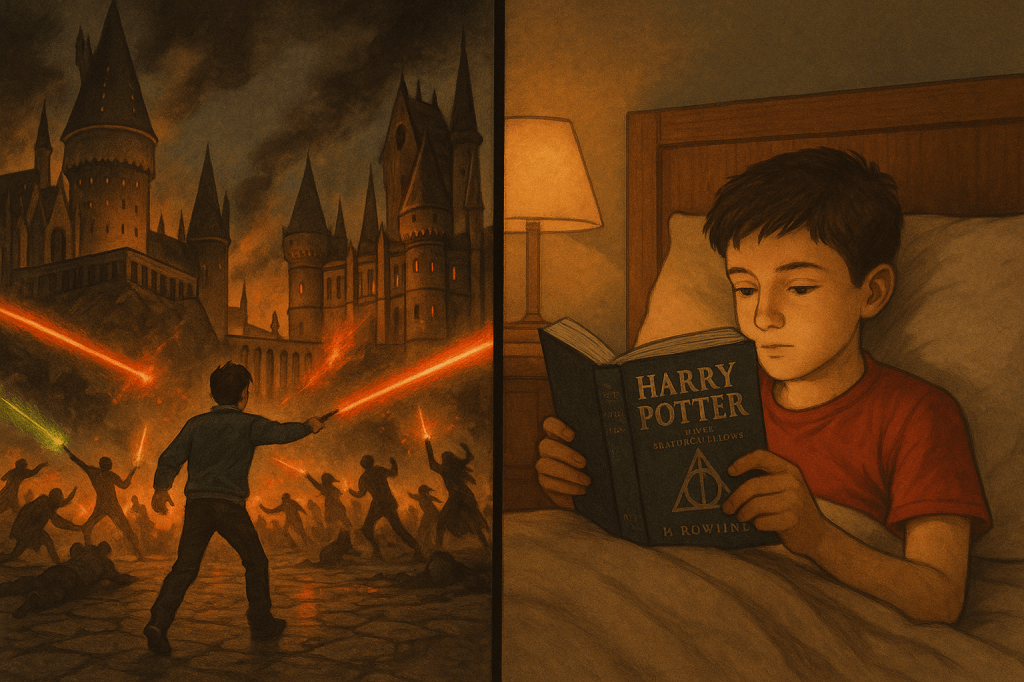
For me, September 1 is more than just a line on the calendar. It’s a reminder of how Harry Potter grew alongside me, how my elder brother became my companion through the magic, and how those books turned into a mirror of my own growing years.
My Hogwarts Express didn’t leave from King’s Cross. It began in the form of books passed down by my brother. I didn’t have a circle of friends to huddle with over theories or heated debates. Instead, I had one person. my elder brother.
I would passionately rattle off my thoughts, predictions, and bewildering theories, while he, with infinite patience, listened. He humored my nonsense, and in doing so, gave me something precious — the feeling that my excitement mattered. That was my own ticket through the barrier.
Some memories of that era are etched into me with unusual clarity. I still remember begging my brother to take me to watch Order of the Phoenix again even though I was terribly sick with jaundice. Nauseated and weak, I should have been in bed. But magic doesn’t wait for fevers to subside.
Just two weeks later, Deathly Hallows released. This time, I was back in bed, still recovering. But the book itself became my medicine. I devoured it cover to cover, fever and all.
By the time Deathly Hallows landed in my hands, I was in my final year of school. Academically, later in that academic year, things didn’t go as well as I had hoped. I didn’t close that chapter of my life with shining marks or accolades. But strangely, the real sense of closure didn’t come from my exams anyway it came from those final pages.
Harry’s battles, his losses, his choices mirrored the struggles of growing up. For me, he wasn’t just a character. He was an alter ego, carrying lessons of resilience, courage, and belonging.
Even in college, Harry followed me. I remember going to see Delhi 6 with my mates. When Amitabh Bachchan and Abhishek Bachchan appeared on screen in that surreal conversation at terrace of Chandani Chowk house, I whispered excitedly, “That’s Albus and Harry talking at King’s Cross!” My friends stared blankly, they couldn’t comprehend what I meant, because the last book hadn’t been adapted yet.
It was one of those moments where fiction spilled out of the pages and into real life, but only I could see it.
The final two films I watched with my girlfriend who would later become my wife. She sat beside me, enjoying the spectacle, but couldn’t quite understand why the New Beginning Theme made me cry. For her, it was just music. For me, it was years of growing up, of farewells, of a chapter closing. Tears rolled down, and I couldn’t even explain it then.
When I turned the last page of Deathly Hallows, it felt like finishing a chapter of my own life. The books had grown with me, year after year, and suddenly, the journey was complete.
But nostalgia is stubborn. It doesn’t let go easily.
And now, the story doesn’t just belong to me anymore. I feel a heavy yet beautiful duty, to pass it on. I can’t wait to hand these amazingly illustrated Harry Potter books to my son when he finally learns the difference between tearing a book apart and truly reading one.
P.S. People sometimes give me that “are you serious?” look when I say “Hogwarts feels like home.” I get it, to them, it’s just fiction. Meanwhile, my friends still pump their fists at “Bring me Thanos!” But honestly? Harry walking back into Hogwarts will always give me bigger goosebumps than a giant purple villain and a Norse god with a hammer combined. If that makes me sound crazy, fine. I’ll proudly be that weird guy who treats September 1 like a holiday. After all, there are far worse places to call home than Hogwarts.
I have always avoided books that make me feel heavy. Stories that linger after the last page is turned. Characters who breathe down your neck long after the book is closed. Truths that feel a little too familiar. I have skipped sad movies and walked away from brooding documentaries. I have leaned toward stories that leave me lighter. I prefer fictions that do not press too hard.
But then, I picked up The Trial by Kafka because my elder brother was reading it.
I do not know why. Maybe it was curiosity. Maybe it was something I could not name. But it did not take long for the absurdity to seep in. Not just the absurdity of the plot. That, in itself, is classic Kafka. But the absurdity of how familiar it all felt. A man trapped in a system, accused without explanation, waiting endlessly for justice while the machinery of the institution grinds forward without a face. As a lawyer, I felt it in my bones.
There is a kind of quiet collapse Kafka writes about. It is not loud. It is not even dramatic. It is just a slow erasure of logic, of fairness, of dignity. And it mirrors what I sometimes witness in real life. Courtrooms echo with purpose, but often carry exhaustion. Files are heard, but not always read. Systems work, but not always for those who need them the most.
I did not plan to carry the book with me, but I did. I took it out for a walk.
It was drizzling. Just enough rain to blur your vision but not enough to stop you from walking. I walked about a kilometer with Kafka in one hand and today’s unread Indian Express folded and tucked inside the book as a bookmark. It was not a literary decision. Just habit. A pause in the absurdity. The paper sagged slightly from the rain, trying to stay relevant for one more hour.
I wanted to walk more. Maybe a couple more kilometers. Let the greyness soak in. Let the words settle, not just in thought but in my limbs. But the day had been long. Court had drained me. Conversations had pulled. So I turned around. My shoes were wet and my mind felt heavier than usual. I came home hoping the mangoes were ripe.
That is the thing about days like this. You carry Kafka in one hand and a newspaper in the other. You walk through the rain with questions that do not end. You feel the weight of institutions and inefficiencies and invisible systems. And yet you come home hoping that there is something soft and sweet waiting in the fridge.
I still do not know why I picked up The Trial. But I know why I will keep reading it.
Not because I want to feel sad.
But because I want to understand why I avoid feeling it.
Let’s talk about wisdom. Not the kind etched into temple walls or whispered by monks on mountaintops. I’m talking about the real, gritty, painfully accurate wisdom that usually shows up after you’ve eaten too much chilli or replied “sure, let’s catch up” to someone who drains your soul.
This kind of wisdom doesn’t glow. It doesn’t trend. It isn’t curated by an influencer in Bali sipping green juice on a bean bag. It’s the annoying voice in your head — the one that says, “You know this is a bad idea, right?” And we, being human and tragically optimistic, go ahead and do it anyway.
Chapter One: That Inner Voice We Treat Like Spam
Every time you’re about to do something dumb, like buy a juicer to ‘start fresh’ even though you’ve never juiced anything in your life, there’s a voice. A small one. Kind of like the mental version of your mom clearing her throat behind you.
It says, “Are you sure?” And you say, “Let me live!”
That voice has been honed by generations of human stupidity. It’s survived wars, heartbreak, and Black Friday sales. But now, its job has been taken over by… algorithms.
Chapter Two: Algorithm Gurus and Their Unshakable Faith
Enter the modern breed of wisdom, the people who are 110% convinced that their algorithm knows them better than their mother, therapist, or bank account.
These are the folks who say things like “The Universe sent me this Reel and I just knew I had to break up with him.”
Or, “My feed is so aligned right now. It’s like, healing.”
They follow accounts that post pastel quotes like, “You are the sun, babe. Burn for no one,” and then proceed to ignore their credit card bill and text someone named Karan at 2:17 AM.
They believe the universe is speaking through TikTok. They get their nutritional advice from astrology memes and use phrases like “retrograde made me do it” while eating nothing but air-fried zucchini chips.
And here’s the kicker, they are so sure. So absolutely confident that their algorithm, their curated bubble of content and confirmation bias, is smarter than centuries of lived human experience. They think they’ve cracked life, love, parenting, finance, and digestion. Meanwhile, the rest of us are quietly Googling, “Can one die from excessive emotional intelligence?”
Chapter Three: The Chilli, the Mistake, the Lesson
Despite all this algorithmic enlightenment, some wisdom never changes. Like the lesson that too much chilli will eventually humble you, no matter how spiritual or gluten-free your diet is.
You can follow all the gut health influencers in the world. You can watch thirty-seven Reels about the benefits of cumin water. But if you eat that extra-spicy paneer tikka because your ego said, “You’re built different,” you will still find yourself holding onto the sink for dear life the next morning, whispering, “Why me, God?”
That, my friend, is when real wisdom shows up. And it’s not in the form of a life coach in Ibiza. It’s your colon saying, “I told you so.”
Chapter Four: The Comeback of Common Sense
After a certain age, usually somewhere between your first heartbreak and your third probiotic… you start hearing the truth again. Not from an algorithm. But from within. The wisdom that says, “Drink water,” “Don’t text him,” and “You don’t need another plant.”
You realize that wisdom isn’t supposed to be sexy or viral. It’s supposed to be useful. Quiet. Annoying. Inconvenient. And deeply, unfailingly true.
It reminds you that kids don’t need martyrs for parents, they need emotionally stable adults. That staying in a relationship out of guilt is like keeping spoiled milk in the fridge “just in case.” And that sometimes, self-care isn’t a face mask. It’s saying no, sleeping early, and unfollowing that one person who makes you feel like you’re failing at life.
Final Thoughts: It’s Okay to Be Dumb (Just Don’t Make It a Habit)
We all have our moments of brilliance and our seasons of idiocy. That’s what being human is. The goal isn’t to be perfectly wise. It’s to be less stupid next time. To recognize when your gut is right, even if your Instagram Explore page is screaming otherwise.
So yes, follow your heart. But maybe cross-check it with your liver. Eat the chilli, but keep some curd nearby. Trust your algorithm, but also remember it thought you were into dog grooming videos for three months because you accidentally watched one pomererian being shampooed.
And when that ancient, boring voice in your head speaks up again? Pause. Breathe. Maybe listen this time.
Because the real wisdom? It’s not trending. But it’s waiting for you. Usually with a glass of jeera water and a slightly judgmental smile.
We often think of memories as gentle things, sepia-toned moments neatly folded in the drawers of the mind. But sometimes, memories bite.
Dante said it best, “There is no greater sorrow than to recall a happy time in misery.” It’s not the pain itself that aches the most, it’s the echo of joy that came before it. A laugh that once rang like music now sounds like mockery. A smile, once comfort, now a ghost.
Change is strange that way. It comes quietly at first maybe disguised as a missed call, a forgotten birthday, a difference in tone , until one day you realize that what was once familiar has become foreign. You stand at the edge of what used to be your world and it doesn’t recognize you anymore.
But here’s the truth no one likes to admit:
Change is not betrayal. Change is just change.
We tend to hold people to the last version of themselves we loved. We expect the friend who once understood every silence to always be that way. The lover who once reached out first to always stay. But people are rivers, not statues. They twist, split, dry up, flood and so do we.
Time doesn’t ask permission.
Even the deepest bonds, no matter how heartfelt, are still mortal. Some grow with us. Others don’t.
We grieve that and we call it loss.
But really, it’s just that life continues on without our consent.
And so, when we sit alone, aching for the echo of a laughter that no longer visits us, when we replay old conversations in our heads like a broken record, we must also remind ourselves: That version of you, the one who laughed in that moment, loved with that heart, believed in that future, still exists. And that matters.
It matters even if the people in that memory have walked away.
Even if you no longer recognize the one who smiled back in that old photo.
Because memory is not always there to heal. Sometimes it comes to teach.
That’s what I’ve been told. In history books. In dinner-table lectures. And perhaps, even in some previous life, I was the vendor handing out a paper cone full of Jhalmuri to a Portuguese man who didn’t know what hit his palate.
You see, while others traded pepper, cardamom, or cinnamon, I, true to my entrepreneurial spirit was probably the guy saying, “Bhaisaab, le lo ekdum chatpata Jhalmuri! Masala extra, emotion free.”
Somewhere, I feel, that’s still who I am.
What is so great about Jhalmuri?
Everything and nothing.
It’s puffed rice, onions, mustard oil, green chillies, peanuts, some bhujia, coriander, tomatoes if you’re fancy, and lemon juice that tastes better when squeezed with existential dread. There is no recipe only instinct. No proportion only impulse. No balance, just chaos in a cone.
And it tastes divine.
My life, lately, has become Jhalmuri.
Too much chilli in the wrong place. Too little crunch. A lot of mustard oil floating on top, trying to pretend it’s holding things together. Every now and then, a surprise bite hits you, hard peanut, burnt rice, or something spicy that shouldn’t be legal.
It’s unstructured, imbalanced, overwhelming, and yet somehow… I keep munching.
People ask, “What’s going on?”
I say, “Life is Jhalmuri, boss.”
You may wonder, what do Europeans have to do with all this?
Absolutely nothing.
But I needed someone to blame. The British took Kohinoor, and I’m taking poetic license. It’s only fair. The bigger question is if we all sold our spices for silk and silver, what did we keep for ourselves?
My answer: Jhalmuri.
Unpackaged. Unbranded. Untamed.
Because when the world feels too much when plans crumble, routines dissolve, and people surprise you with their odd mix of sweetness and spice I don’t crave order. I crave Jhalmuri.
Maybe, just maybe:
Life is not meant to be a neatly plated continental course. It’s meant to be a roadside snack. Messy. Spontaneous. Eaten standing up while dodging traffic, opinions, and one’s own expectations.
So here’s to Jhalmuri.
May your life be as unapologetically unpredictable, mildly crunchy, and beautifully imbalanced.
There’s a strange thing about victories. You wait for them. You prepare for them. You put your blood, your time, and your breath into chasing them. And then, when you finally hold them in your hand, they’re not quite what you expected.
As I sit down to write this, the thought is still forming. It’s not quite an article, not quite a diary entry—maybe just a mirror I’m holding up to myself. Maybe by the end of it, I’ll find an answer. Or maybe I won’t.
There was a time when I believed that the highest high I could ever feel would be clearing a competitive exam and becoming a judge. That image had become a kind of religion for me—waking up before the world, wrestling with law books, and imagining the day I’d be addressed as Your Honour.
Then I fell in love. Thought marriage would be the peak. I had someone in mind, someone from my college days. The story made sense in my head—two people who’d grown, evolved, and eventually found their way back to each other. That would be my “happily ever after.”
Then I held my newborn son in my arms. Life changed in that moment. His tiny heartbeat against my chest made me feel like everything had a reason. Surely, this was the ultimate high?
Turns out, life doesn’t work on a linear path of escalating highs. It isn’t a mountain with one glorious summit after another. It’s more like waves. They rise, they crash, they recede. And sometimes, you’re just floating, not knowing if the next wave will lift you or drown you.
Today was one of those “high” days. Four civil suits filed. Four injunctions granted. Everything went by the book. Sharp. Clean. Perfectly executed. I should’ve felt like a warrior coming back from battle. And for a moment—I did.
Then I sat in my car.
And just like that, a strange silence fell over me. The kind of silence that isn’t peaceful but empty. The kind that swallows applause, ambition, and even pride.
Suddenly, it felt like nothing mattered.
I don’t mean that in a cynical way. I wasn’t sad. I wasn’t depressed. I was just… still.
And in that stillness, a truth emerged.
The real difference today wasn’t made by me.
It was made by that judge.
Not just a person occupying a chair, but someone who truly deserved to be there. Someone who understood the essence of justice—not just its letters, but its spirit.
It hit me then—maybe there’s no grand purpose or inferior purpose. Maybe purpose isn’t something to find or chase. Maybe it’s just… doing your job. Honestly. Consistently. Quietly.
Maybe the only real thing in this profession, or perhaps in life, is the integrity with which you show up each day. That’s it. No music. No medals.
Sometimes, I joke to myself—maybe I should leave it all behind and become a hermit. Just disappear into the woods with a few books, a warm blanket, and silence.
But even that is probably just another high I’m dreaming of. Another summit in disguise.
For now, I’ll return to work. I’ll keep filing, keep arguing, keep hoping. And maybe, once in a while, I’ll write.
Because maybe, just maybe, there’s some purpose in that too.
Let’s talk about financial planning. Or as I like to call it: “A tragicomic fantasy written by someone who has clearly never had to skip dinner to afford petrol.”
You see, I recently came across this beautifully organized financial chart titled “How to Organize Your Finances.” It looked like it was designed by someone who probably uses “legacy” as a verb and drinks smoothies that cost more than my monthly electricity bill.
The chart was a masterpiece. It broke down your paycheck into thoughtful categories like Fixed Expenses, Living Expenses, Long-Term Savings, Mid-Term Savings, and Short-Term Goals. Then it whispered sweet financial nothings like “Retirement Fund,” “Investment Account,” and “High-Yield Savings.”
Adorable.
But here’s the thing: This entire plan assumes one major thing—that you actually have money.
Which brings me to my point: What if your job is a tragedy and your salary is a joke?
Let me walk you through my version of this financial plan:
INCOME
Expectation: Monthly paycheck deposited.
Reality: Salary arrives with the emotional commitment of a teenage boyfriend—late, inconsistent, and full of excuses.
Retirement Fund: Just a polite way of saying “Die working.”
EXPENSES
Let’s get one thing straight—everything is an expense. Even staying alive.
FIXED EXPENSES
Bills: Mostly reminders of poor life choices.
Debt: Yes. Next question. Subscriptions: Netflix and denial. Health: God bless generic paracetamol. Insurance: Only thing more invisible than my savings.
LIVING EXPENSES
Food: Maggi is a food group, right? Fun: What’s that?
Clothes: Hope the holes in my socks count as ventilation.
Gas: Pray, ride, repeat.
SAVINGS
Short-Term: Emergency fund? You mean like that ₹70 I keep in my sock drawer?
Mid-Term: Vacation fund? Yes, I take daily mental vacations to the Maldives during 5 minutes of poop time.
Long-Term: Retirement savings? Sure, I’ve saved enough to buy myself a chocolate bar in 2047.
Ongoing Funds: My only ongoing fund is “Pretend This Isn’t Happening Fund.”
INVESTMENTS
In Myself: Questionable return.
In theStock Market: I once put ₹500 in a mutual fund. It’s now ₹472.38.
In Hope: Currently trading at an all-time low.
You see, it’s not that I don’t want to follow this beautifully crafted budget—it’s just that my paycheck comes, waves a sad little hello, pays rent, and disappears faster than my self-esteem during appraisal season.
But hey, we’re not giving up. We’re just…financially flexible. We don’t have a “retirement account”—we have vibes. We don’t invest in stocks—we invest in coping mechanisms. And we don’t save for emergencies—we ARE the emergency.
So here’s to financial planning in the time of emotional damage and economic heartbreak.
Because when your job is a tragedy and your salary is a joke—laughter may be the only thing you can afford.
P.S. I put this blog on a high-yield savings account. It earned two likes and a pity comment from my mom.