There was a chapter in a game once—Endless Summer, in Bully. I remember finishing it and thinking—this wasn’t fun. You may disagree, game indeed was fun, but relentless sun, and chasing shadows once game is finished rarely spell joy.
Aa Now, decades later, that fictional summer seems to have leapt out of the screen and onto the streets of India. And let me tell you—it’s not fun to play.
As a lawyer, my daily uniform is a black coat. A fine choice in winter, a professional necessity in spring—but in April 2025? It feels like I’m cosplaying as charcoal. I’ve surrendered. Not to the heat alone, but to air-conditioning and a tall glass of chilled lassi. My only rebellion is that I haven’t started commuting by camel yet. But give it time. With India mirroring sub-Saharan temperatures, maybe that’s the next logical step.
This isn’t just dramatic prose—this is data-backed dread. According to the Climate Change Institute, University of Maine, the temperature map from April 7, 2025, paints a sobering picture. India is blazing, glowing red-hot like it’s auditioning to be the new Sahara. And it’s not even peak summer.
Climate change has a peculiar way of sneaking up on us—first as headlines, then as heatwaves, then as altered routines. We shrug, we adapt, we install another AC. But adaptation isn’t a solution, it’s a sedative. And while we cool our homes, the planet continues to warm.
There’s a cruel irony in all this. The earth is getting hotter and hotter—but not in the Salma Hayek way. It’s not Chris Hemsworth hot. It’s hemisphere-on-fire hot. The kind that makes you rethink dress codes, urban planning, public transport, and planetary priorities.
Maybe the answer isn’t just in policy or protest. Maybe it’s in satire, awareness, and sweaty, honest conversations. Maybe it’s in writing this post, somewhere between courtroom rounds and a glass of buttermilk, hoping someone reads it and thinks: This isn’t normal. This shouldn’t be normal.
Till then, I’ll keep my black coat, my lassi, and perhaps order a Saharan robe—because if I can’t save the planet, I can at least survive it in style.
The EMIs are snoozing quietly in my netbanking tab.
My phone is on silent.
The kitchen is cleaned and waiting for a peaceful morning brew.
And I’m sweating like I’m in the Sahara because I just dreamt that my 12th board exams start in 23 minutes and—surprise!—I haven’t studied a single chapter of organic chemistry.
Why?
Because clearly, my subconscious thinks the only thing standing between me and “being a responsible adult” is my inability to balance a redox reaction or draw the graph of sin²x. Not the fact that I haven’t had an emergency fund since 2015 or that my idea of a workout is chasing my toddler with half a sock in his mouth.
Two decades. Two whole decades since I last touched a Class 12 textbook.
Since then, I’ve learned how to do my taxes, write emails that start with “Hope this finds you well” and end with “Thanks & Regards,” and calculate discounts while shopping like a NASA scientist on a budget.
But nope—my brain still thinks “life preparation” means memorizing the periodic table.
And you know what’s worse?
These dreams don’t strike when I’m solving life crises.
No, they arrive when I’m at my happiest.
Planning a long weekend. Finally about to sit on the couch and sip the coffee made by my lovely wife.
Basically, just when I start to believe I’ve earned a moment of peace, boom!
“Kya Jayendra, is this the time to relax? Have you revised thermodynamics?”
I once tried to talk to a therapist about this. She said, “It’s a common dream. A metaphor for feeling unprepared.”
I wanted to say, “Ma’am, at this point, even my nightmares are repeating syllabus.”
But maybe ChatGPT was right when it said my dreams reflect my fear of being unprepared for life.
The problem is—what part of life can I even prepare for?
Marriage? There’s no chapter in NCERT titled “How to say ‘I’m sorry’ even when you don’t know why.”
Parenting? No worksheet prepares you for “What to do when toddler uses toothpaste as wall paint.”
Finance? I know trigonometry but I still don’t know where my PF account is.
So yes, I may not be ready for every twist and turn in life.
But I am ready to face one fact:
I will never escape the ghost of Board Exams.
And as long as I keep running low on sleep, insurance, and backup plans… my subconscious will always be that annoying invigilator in the dream who says: “Five minutes left. Attempt all questions.”
So, dear dream:
Let me live.
Let me sit.
Let me sip my coffee.
And please, for the love of caffeine and adulting…
Let me begin with a confession: I once stole a pencil from my classmate in 4th grade. It was a Nataraj, freshly sharpened, with that glossy black body. Beautiful thing. I still remember the thrill — and the guilt — which lasted a whole 14 seconds before I used it to draw a mustache on my math textbook cover.
Fast forward two decades: I’m stuck in traffic, it’s 45 degrees outside, Spotify is buffering, and I haven’t had my coffee. That’s when it hits me: Karma. The universe is finally collecting payment for that pencil. And the mustache.
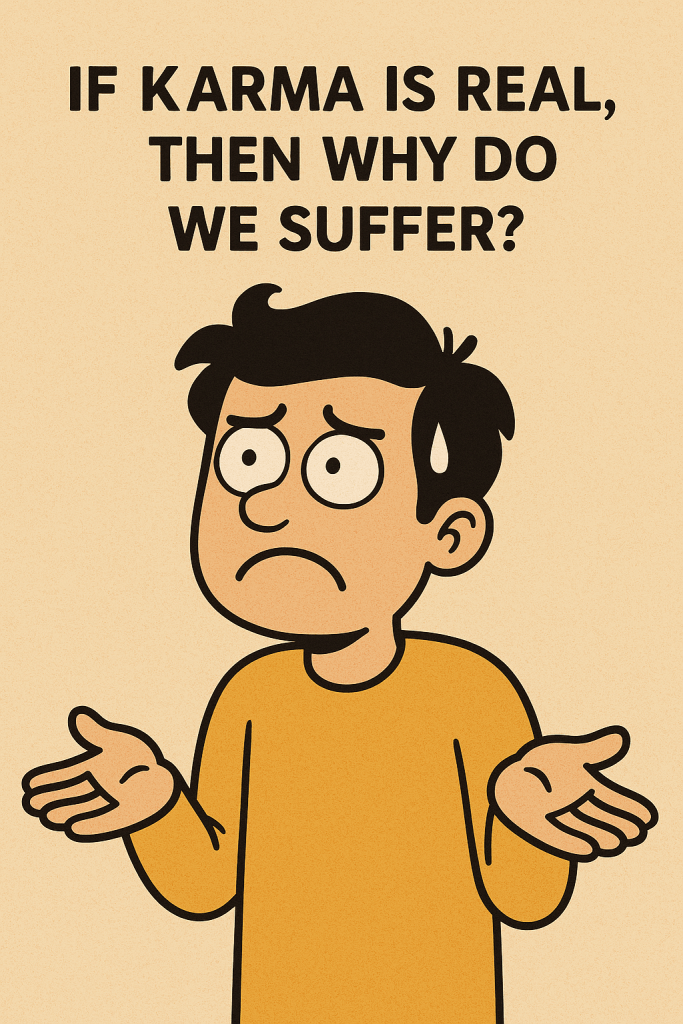
But here’s the twist — if karma is real, and it’s keeping track of every cosmic pencil theft and emotional drama, why do good people suffer? Why is my neighbor, Mrs. Sharma, who feeds stray dogs and prays more than Google listens, still dealing with arthritis and a leaking ceiling?
And why does that guy from school — the one who used to cheat in exams and steal lunch boxes — now own a startup, a BMW, and probably a yacht named “Destiny”?
The Cosmic Customer Complaint
If karma had a helpline, I’d call it.
“Hello, this is Karma Support. For English, press 1. To complain about suffering, press 2. To ask why your ex is thriving, press 3. To speak directly to your past-life manager, stay on the line…”
You wait for 12 lifetimes. Still no answer.
Turns Out, Karma Isn’t Amazon Prime
See, we’ve misunderstood karma. We want instant results. Bad action? Punishment by Friday. Good deed? Reward in 3-5 business days.
But karma isn’t a vending machine — it’s more like a very old, wise librarian with a really long queue and zero interest in your Instagram likes. It works on a time scale that makes glaciers look fast.
That headache you got this morning? Maybe it’s not from too much screen time. Maybe it’s your past-life self who ghosted someone in the 1800s. You just never know.
Suffering: Karma’s Weird Cousin
So why do we suffer, if we’re not all villains in disguise?
Some say it’s to balance things out. Some say it’s to learn. And some say it’s because we tried to eat roadside chole bhature at 11 PM. All valid theories.
But maybe, just maybe, suffering isn’t a punishment — it’s part of the human mess. Like uninvited relatives during wedding season, or that one friend who borrows your charger and disappears.
Maybe the point isn’t to avoid suffering but to go through it without becoming bitter. Maybe the point is to laugh at the absurdity of it all — like I did when I slipped in front of my crush and blamed the “uneven aura energy.”
In Conclusion (Because Every Blog Needs One)
Karma probably exists. So do traffic jams, heartbreak, power cuts during IPL matches, and neighbors who drill at 7 a.m. But while we wait for the universe to sort out our celestial report cards, we might as well:
• Be kind,
• Laugh often,
• Avoid stealing pencils (especially the good ones),
• And remember — the universe may be slow, but it never forgets. Not even that time you said you were “on the way” when you hadn’t left home.
Now, if you’ll excuse me, I need to meditate, or at least pretend to — just in case the universe is watching.
Life, my friends, is like that one WhatsApp group you can’t leave because your aunt keeps sending “Good Morning” flowers made on Microsoft Paint. You don’t want to be rude, but also… you want out. That’s what life feels like sometimes—like an unskippable ad for something you didn’t order and never signed up for.
And oh, the thirst to escape? It’s not just there—it’s practically a personality trait now.
But let’s take a moment. Is this deep-rooted desire to disappear and become a potato in a Himalayan cave truly your own, or is it people-driven?
Maybe.
Not maybe.
Absolutely, yes.
It begins with your parents, who lovingly plant the seed:
“You were born to do something great.”
(Translation: You better top the class or don’t come home.)
Then comes school:
“Why can’t you be more like Sharma ji’s son?”
(Sharma ji’s son is now in Canada and sells crypto advice on Instagram.)
Then the astrologer chimes in with his unsolicited prediction:
“Jupiter in your fourth house means you’ll become famous.”
(You go viral once—for tripping over your own foot on CCTV footage. That’s it.)
And how can we forget that companion who looked into your eyes, cupped your cheeks and said:
“I love you for who you are.”
Spoiler alert: They now love someone else who’s mysteriously more of who you are but with abs and a dog.
So yes, this need to escape—to run away and start a new life as a barista in Manali or a monk in McLeod Ganj—is very much people-powered. You didn’t sign up for the pressure, the heartbreak, or the astrologer. You just wanted to live. Maybe eat some noodles. Maybe sleep in peace. Maybe not be compared to Sharma ji’s son every other day.
And don’t get me started on failures. The real MVPs of your escape fantasy. You try one startup, it fails. You post one reel, it tanks. You join a gym, your attendance card starts gathering dust like your ambition.
Each failed attempt turns into a voice in your head whispering:
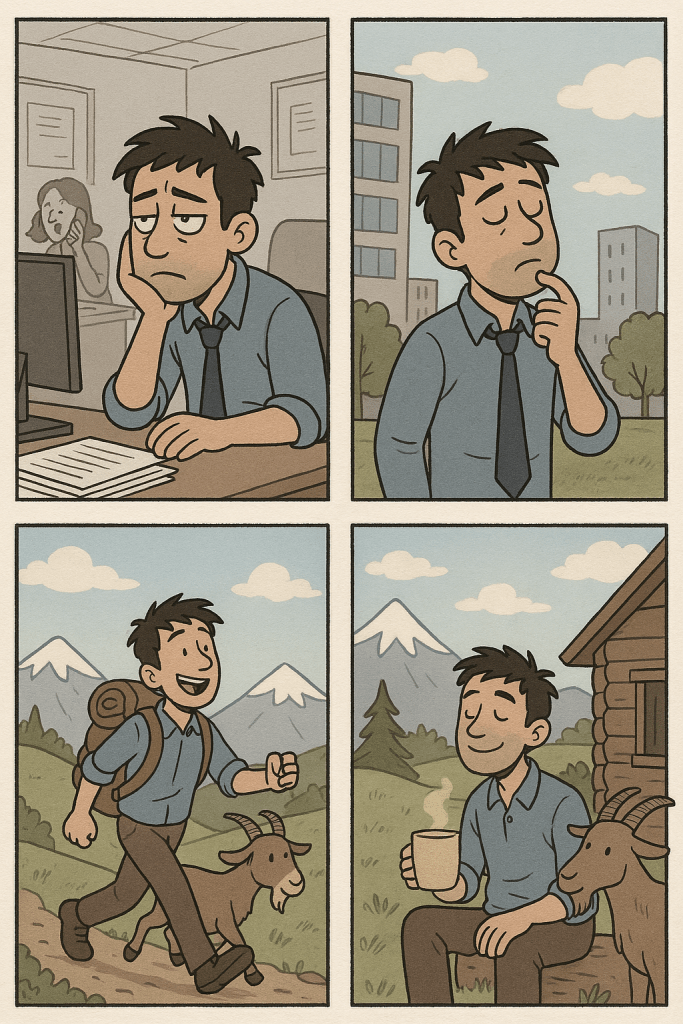
“Maybe you were meant to herd goats in the mountains.”
In conclusion, escaping life isn’t really about life. It’s about the characters life introduces you to. The unsolicited advice givers. The lovers turned philosophers. The dreamers who became memes.
But here’s the thing: Even when you want to escape, you stay. Why?
Because deep down, you know the joke’s not over yet.
And maybe—just maybe—one day, you’ll be the one sending “Good Morning” Paint flowers… from your cabin in the hills, sipping tea, herding goats, and laughing.
Have you ever watched a movie where the protagonist embarks on a life-changing journey? One moment, they’re out of shape, heartbroken, or clueless, and then—BAM!—a three-minute montage later, they’re fit, successful, and radiating wisdom like they just unlocked the secret to life. Meanwhile, here I am, walking in circles to hit my step goal, waiting for my smartwatch to acknowledge my suffering, and wondering why my transformation isn’t happening in 180 cinematic seconds.
Lately, transition videos on social media have made me even more envious. You see someone put an onion on the counter, snap their fingers, and next thing you know, it’s perfectly chopped and sizzling in the pan. Meanwhile, I’m here wrestling with an onion that refuses to be peeled, wiping away tears like I just watched Kal Ho Naa Ho, and questioning all my life choices.
Wouldn’t it be amazing if real life worked like that? Imagine skipping all the hunger pangs while dieting—just snap your fingers and boom, you’re full. Or skipping the lower back pain from walking for weight loss—one quick hand gesture and you’re suddenly fit, with abs and all. No waiting. No suffering. Just results.
But, of course, life doesn’t work that way. Life wants you to feel everything—the soreness, the cravings, the failed attempts at cooking a “simple” meal that somehow turns into a disaster. Because, as much as I hate to admit it, that’s how real transformation happens. If we could fast-forward through all the struggles, would we even appreciate the outcome?
So, while I’d love a montage or a magical transition, I suppose I’ll keep chopping my onions the hard way, taking my slow, painful steps toward fitness, and embracing the chaos of real life. Because when I do get there—wherever there is—I’ll know I earned it.
Have you ever stumbled across something so absurdly perfect that it made you laugh out loud? Well, meet Exhibit A: this tree. A coconut-palm-banana-jackfruit hybrid masterpiece, this marvel of nature looks like it rolled out of the dreams of someone who took the phrase “why have less when you can have it all” a bit too literally.
The tree is a hilarious metaphor for life. It’s everything we expect life to be: a limitless buffet of success, prosperity, and happiness. Look at it! Bananas for your health goals, coconuts to quench your thirst for exotic vacations, and a massive jackfruit symbolizing that one giant dream you’re sure will make you “complete” (or at least make Aunties at weddings stop asking when you’ll achieve “something meaningful”).
But then comes reality, and oh boy, does it hit hard. Let’s break it down:
1. The Bananas of Hope
Ah, bananas—reliable, sweet, and perfect for Instagram fitness posts. But in life? These bananas are that early-career confidence where you think, “I’m destined for greatness.” Yet, much like when you try to store bananas for too long, things quickly start to rot. Promotions? Delayed. Side hustle? A side flop. Suddenly, the bananas aren’t golden anymore—they’re black, squishy, and attracting metaphorical flies called “EMIs.”
2. The Coconuts of Endless Possibilities
Coconuts represent those daydreams about the “perfect” life: sipping fresh coconut water on a beach while your passive income rolls in. Except, just like real coconuts, life makes you WORK HARD to crack it open. Instead of paradise, you’re stuck wrestling with Excel sheets and wondering why your boss emailed you at 2 a.m. Meanwhile, your vacation fund has evaporated faster than the water in said coconuts.
3. The Jackfruit of Lofty Ambitions
Now let’s talk about the jackfruit. That giant, spiky symbol of our wildest, most audacious dreams. It’s the career-changing startup idea, the dream house, the six-pack abs. But here’s the thing about jackfruit: it looks cool from afar but is insanely hard to deal with up close. Sticky, smelly, and requires the patience of a saint to enjoy—yep, that’s your mid-life crisis summed up.
4. Reality Check: The Missing Fruits
And of course, you’re left wondering—where are the mangoes? Isn’t life supposed to be sweet and juicy? Well, spoiler alert: the mango tree is two blocks over, and it belongs to your neighbor who just bought a Tesla.
The funniest part of this tree is how it reflects our belief that life will give us everything all at once, all perfectly ripe and ready. In reality, though, it’s more like an awkward salad: some sour, some sweet, and a lot of random bitterness thrown in for good measure.
So, what’s the takeaway here? Life’s a tree—but not this overachieving mutant. Most of us are just out here with our scraggly little saplings, praying for one ripe fruit that isn’t snatched away by squirrels (aka rent, inflation, and bad luck). And that’s okay! Embrace the chaos, laugh at the absurdity, and enjoy whatever falls from your tree—even if it’s just a bruised banana.
After all, even a quirky tree like this one is a reminder: life might not give you what you want, but it sure gives you one heck of a story!
In the stillness of night, a sacred ritual unfolds in our home. My toddler, wrapped in his own cocoon of innocence, finds his way to my shoulder, clutching his beloved elephant and a soft blanket. His big, trusting eyes look up at me, and he whispers a simple request: to hear his favorite bhajans before sleep. It’s a nightly habit, but more than that, it’s a moment of quiet validation—a reminder that, in his world, I am his protector, his comfort, his hero.
Recently, I created an image capturing this small yet monumental moment. In the picture, my son stands with a heroic stance, facing down an army of slightly creepy, imaginative monsters. He holds his elephant by the tail and his blanket like a shield, ready to face whatever the night may bring. There’s a kind of courage in him, however playful and dreamlike, and as a parent, I see that courage every night when he trusts me to keep him safe in the face of his own dreams.
It’s easy to overlook these small gestures. In the busyness of parenthood, we’re often focused on providing, protecting, and preparing for our child’s future. Yet, it’s moments like these—when he places his faith in me, seeking comfort in a song, snuggled close—that I feel an unspoken affirmation. Parenting can be filled with uncertainties, questions of whether we’re doing things “right.” But in these tender rituals, my son offers his own validation, silently telling me I’m his source of warmth, security, and stability.
Each night, as I sing his favorite bhajans, I feel a deep sense of purpose. I’m not just singing to lull him to sleep; I’m helping him build a world where he feels safe and cherished, a world where his imagination can run free. Those bhajans become more than melodies—they’re a nightly anthem of connection, grounding both of us in the present moment.
As he drifts to sleep, I wonder what monsters he might face in his dreams and how I can be there to help him through them as he grows. One day, he may face the challenges of the world on his own, but for now, I am his ally against all things real or imagined. The beauty of this simple act, of being his safe place, reminds me that validation doesn’t always come from grand gestures. Often, it’s found in these small, repetitive rituals that slowly build the foundation of trust and love.
I’m grateful for these moments when my son holds on to me, asking for a lullaby to calm his mind. It’s a nightly reminder that my role, though at times unseen, is profoundly meaningful. He may be the one holding his toy elephant like a warrior, but through his need for me, he’s also gifting me a validation that’s both humbling and profound.
In his eyes, I am more than just a parent. I am his comfort, his warmth, his hero—ready to battle any monsters, real or imagined, that might come his way. And as long as he holds onto that belief, I am validated in the best way I could ever hope for.
In every Indian family, there’s an invisible rulebook that no one gives you but somehow expects you to follow religiously. These cultural norms aren’t written down anywhere, yet they govern everything from how much food you should eat to how many gifts you should give. It’s like you’re constantly participating in a family Olympics where everyone else already knows the rules. So, let’s take a lighthearted look at some classic cultural expectations that are bound to leave you both puzzled and amused.
1. “Arey Beta, Thoda Aur Lo” – The National Anthem of Family Meals
You’ve just finished your second plate of poori and sabzi, feeling like you’ve eaten enough to feed a small village. But the moment you lean back and say “Bas, ho gaya,” your aunt gives you a look like you’ve just committed a sin. Enter the most common phrase in Indian households: “Arre beta, thoda aur lo!”
Refusing food is practically forbidden. You say “no” three times, but on the fourth time, the food magically appears on your plate anyway. There’s no escape. And don’t even think about saying you’re on a diet—because the next thing you know, your plate will be filled with extra ghee and love.
2. व्यवहार – The Mandatory Gift Exchange Ritual
Let’s talk about व्यवहार, that unsaid rule when a married daughter and her husband visit the parents’ house. It’s almost like a hidden clause in the Indian Family Contract. Whether it’s a mithai ka dabba, cash, or sarees, something must change hands. And it doesn’t matter if the son-in-law politely protests; there’s always that one aunt or uncle who sneaks an envelope into his pocket.
Of course, the son-in-law’s refusal is part of the dance. “Nahi, nahi, yeh toh bahut zyada hai!” he says, while graciously accepting. This ritual is as much about maintaining family bonds as it is about creating the perfect setting for post-visit gossip.
3. The Never-Ending “Shaadi Kab Hai?” Question
Every family gathering has a mission: finding out when you’re getting married. You could be 22 and just starting your career, but that doesn’t stop the relentless stream of questions: “Aur beta, shaadi kab kar rahe ho?”
If you’re already married, don’t think you’re safe. The next barrage will be about babies. And if you have one kid, they’ll ask when the second one is coming. It’s like an endless relay race where the baton is passed from one life event to the next. You’re never allowed to just… chill.
4. Touching Feet: A Full-Body Workout in Disguise
You think you’re fit? Try surviving a family function where you’re expected to touch the feet of every elder present. It’s not just a gesture of respect—it’s an impromptu workout. You bend, they bless, and you smile. Repeat this 10 times and you’ll realize that gym memberships are overrated.
The best part? Half the elders don’t even recognize you. “Kaun hai yeh?” they’ll ask your parents, and you’ll just nod along, grateful that the ritual is at least keeping you in shape.
5. The Wedding Gift Tug-of-War
Attending a wedding isn’t just about celebrating love—it’s also about navigating the delicate art of gift-giving. You give too much, and the recipients will feel awkward. Give too little, and you’ve just triggered a family scandal. Wedding gifts are tracked with the precision of a finance report, and trust me, people remember.
“Aree, humne toh unke bete ki shaadi mein ₹5,001 diya tha, lekin unhone humare yaha sirf ₹4,501 diya!” This one-sided economic downturn will be discussed at family gatherings for years to come.
6. Festival Fashion: Getting the Colors Just Right
Festivals in India come with an unspoken dress code, and heaven help you if you don’t get it right. Show up at Holi in the wrong shade of white or forget to wear the traditional yellow on Vasant Panchami, and suddenly everyone’s looking at you like you’ve upset the balance of the universe.
And of course, there’s that one relative who will always remind you that black is inauspicious. If you forgot this fact and dared to wear a black kurta, brace yourself for whispers about how you’ve single-handedly jinxed the entire festival.
7. Unsolicited Health Advice: The Lifelong Battle
No Indian family function is complete without someone commenting on your weight. If you’ve lost a few kilos, you’ll hear, “Beta, kuch khaya karo.” If you’ve put on a little weight, it’s, “Beta, thoda sambhal ke khao.” The irony, of course, is that this advice is often dished out while the aunt or uncle in question is devouring their third plate of samosas.
It’s a lifelong battle. No matter how hard you try to look your best, there will always be someone reminding you that you could do better. Welcome to the world of perpetual body commentary.
8. RSVPs Mean Nothing in Indian Weddings
Weddings in India are an event of epic proportions, where the number of guests always exceeds expectations. You send out 200 invitations, but somehow 400 people show up. There’s always an army of distant relatives you’ve never heard of, but who make their grand appearance like VIPs at the red carpet.
And let’s not forget the food. You start with some chaat and pani puri, but by the time you’ve reached the biryani and gulab jamun, you’ve entered into a food coma. But no, you’re not done yet—because declining food at a wedding is a crime worse than missing the bride and groom’s first dance.
Conclusion:
Cultural expectations in Indian families are like the invisible threads that hold everything together. Sure, they can be confusing, sometimes exhausting, and occasionally hilarious. But at the end of the day, they’re what make family life so unique and memorable. So the next time you find yourself in the thick of it, just remember to smile, say “no” four times before accepting that extra paratha, and enjoy the ride—because this is what family is all about.
Imagine this: You’re sitting at your desk, sipping coffee, scrolling through your regrets — I mean, your memories. Maybe you shouldn’t have eaten that suspicious Chaap in 2016. Maybe you shouldn’t have taken up that “one-size-fits-all” parachute deal. Or, perhaps, just perhaps, you should have passed on texting your ex at 2 a.m. after that 4th beer. (we’ve all been there).
What if you could signal your past self to avoid these catastrophes? And not in some heavy, dramatic “time-travel-gone-wrong” sci-fi way, but with a casual, “Hey, past me, maybe skip that third slice of cake, yeah?”
Welcome to the wacky world of parallel Earths—where every bad decision you’ve ever made can be neatly avoided. But here’s the kicker: you don’t get to benefit from the good decision. Nope. That privilege goes to your alternate self, living in some other reality, laughing at how they totally dodged the cringe moments you’re still haunted by. Nice.
So, how does it work, you ask? Let me paint a picture of what it’s like to send messages across timelines.
1. Step One: Admit You Screwed Up (Again)
You wake up at 3 a.m. in a cold sweat, remembering how you thought investing in crypto dog-themed coins was a “genius” move. You realize your alternate self could be right now on the verge of making that same, glorious financial nose-dive. It’s time to help a parallel brother out. Fire up the Time Message App (because obviously that exists in this universe), and type out, “Dear Past Me: No, buying Doge 2.0 won’t make you a millionaire. Trust me.”
Send. Now go back to scrolling through Zillow listings of houses you won’t be buying.
2. Step Two: The Art of the Perfect Warning
Now, here’s the thing about warning your past self: You’ve got to be subtle. After all, you’re dealing with someone who thought wearing socks with sandals was perfectly acceptable once. You can’t just scream, “DON’T DO IT” or your past self will definitely do it out of sheer spite. You have to be smooth.
Let’s say you’re about to warn 2010-you about that shady job offer you got from “CryptoSolutions Unlimited.” Instead of “Run away, fast,” you message, “Hey, maybe ask them what they actually do for a living before signing anything.” See? Classy.
3. Step Three: Laugh as Alternate-You Thrives
You’ve done it. You’ve sent the warning, and alternate-you has avoided disaster. Naturally, their life now becomes perfect. That past taco decision? They skipped it and never spent the night regretting it on the bathroom floor. They didn’t blow all their savings on NFT art of cartoon penguins, and now they’re probably relaxing on a beach somewhere, sipping piña coladas while you’re sitting at home googling “how to sell penguin NFTs for rent money.”
The upside? While they’re busy being fabulous, you get the pleasure of knowing that some version of you has figured it all out. The downside? This isn’t your reality. This is still the one where you thought bangs were a good idea.
4. Step Four: Handle the Unintended Consequences
There’s a catch, of course. Altering decisions in the past could have ripple effects—especially in parallel universes. So, while alternate-you is living their best life, their universe might be dealing with some unintended side effects.
Maybe your parallel self avoided eating that cake at a party, only to end up in an awkward conversation with a stranger that spiraled into a job offer in clown college. Now they’re a world-famous clown with a deep existential crisis.
Or worse: you warned them not to date that one person, and now that person ends up becoming a villain in their universe. Oops. That’s on you, buddy.
5. Step Five: Resist the Urge to Overdo It
The temptation to go full-on life-coach for your past self is strong. You start thinking: “What if I tell them to start working out earlier? What if I tell them to avoid watching Cats the movie?” Before you know it, you’re bombarding them with daily messages.
But here’s the deal: nobody likes a micromanager—not even your alternate self. So, chill out. Let them make a few bad decisions of their own. After all, where’s the fun in life if you can’t make mistakes and laugh about them later? Plus, maybe they’ll send you a message one day: “Dude, lay off the advice. I’m just trying to vibe.”
The Final Thought: Embrace the Chaos
So, is signaling your past self in a parallel Earth a foolproof way to fix your life? Nah. But it’s fun to imagine, isn’t it? Mistakes are part of what make us, well, us. They’re why we have good stories, questionable tattoos, and random trivia knowledge that nobody else cares about.
Sure, maybe some version of you somewhere else has everything figured out, but here’s the truth: This version of you? The one reading this right now? You’re doing just fine. Even with the bad decisions, weird haircuts, and questionable investment choices.
Because at the end of the day, if parallel universes exist, we’re all just making it up as we go—one plate masala chaap at a time.
And who knows? Maybe your alternate self is sending you a message right now. Maybe they’re saying, “Hey, you turned out okay. Don’t stress. And P.S., avoid ordering that masala chaap l”
Well, hello there! How are you doing? Have you been to London to see the Queen? Because if you have, I’m sure her corgis are probably happier than I am right now. I’ve been stuck in this feeling—you know, the one where you’re trying to convince yourself everything’s fine while simultaneously Googling “how to get a fresh start in life” like it’s a new salad recipe?
Lately, I’ve been feeling like one of those abandoned shopping carts at the back of a parking lot. You know, the ones that nobody bothers to return but everyone silently judges. Yep, that’s me! You see, I’ve been sad. And not just the I’ve-spilled-my-coffee sad—I’m talking about the deep kind, the one that makes you feel like you’ve let down every person who ever loved you, including that kid who waved at you from a school bus once.
Somewhere along the way, the vibrant connection I had with the people I care about has poof disappeared, like my enthusiasm after the third day of a new diet. It’s like we were this perfectly synced group, and now I’m the WiFi signal they forget to reset. And, just when I thought I was spending quality time with friends and family, guess what? I overheard them talking behind my back. Yes, I did the thing you’re not supposed to do—eavesdropped on a conversation that was clearly not meant for my ears. But in my defense, what am I supposed to do with all these unresolved trust issues? Go to therapy? Probably, but instead, I’m writing this blog.
Isn’t it just wonderful? You think you’re having a good time, and suddenly you hear, “Oh, did you hear about so-and-so? They’re really just not as fun anymore.” Cue the internal screaming. And just like that, you start questioning everything from your personality to your hairstyle. But hey, what’s life without a little self-sabotage, right?
Now, I’ve been through a lot of things, but I never thought I’d miss feeling like myself the most. And let’s be honest: that’s the real kicker. Of all the things in life—good food, sunny vacations, Netflix binges—what you really miss the most is you. The you that didn’t overthink every glance, comment, or meme. The you that didn’t feel like a ghost at your own party.
But life has its funny ways, doesn’t it? Even in the sad moments, I find humor creeping in like that awkward friend who shows up at the wrong time. You can either laugh at it, cry about it, or do both at the same time. I highly recommend the third option—it’s great for multitasking.
So here I am, lost somewhere between feeling nostalgic for my old self and making a mental note to buy a pack of corgi-shaped cookies the next time I’m at the store. Maybe I’ll even visit London one day. Who knows, I might run into the Queen. And if she asks, I’ll tell her the truth: “Ma’am, I’m just trying to feel like myself again.”