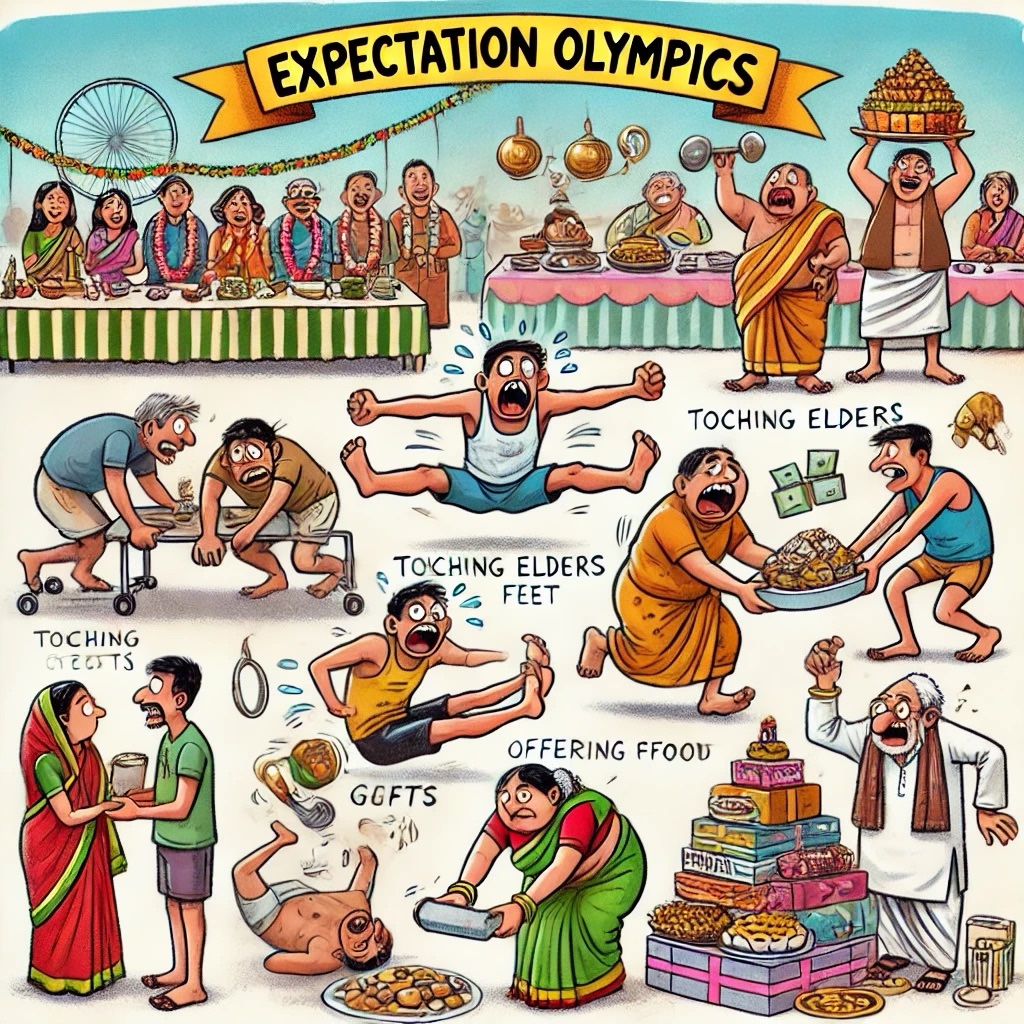
In every Indian family, there’s an invisible rulebook that no one gives you but somehow expects you to follow religiously. These cultural norms aren’t written down anywhere, yet they govern everything from how much food you should eat to how many gifts you should give. It’s like you’re constantly participating in a family Olympics where everyone else already knows the rules. So, let’s take a lighthearted look at some classic cultural expectations that are bound to leave you both puzzled and amused.
1. “Arey Beta, Thoda Aur Lo” – The National Anthem of Family Meals
You’ve just finished your second plate of poori and sabzi, feeling like you’ve eaten enough to feed a small village. But the moment you lean back and say “Bas, ho gaya,” your aunt gives you a look like you’ve just committed a sin. Enter the most common phrase in Indian households: “Arre beta, thoda aur lo!”
Refusing food is practically forbidden. You say “no” three times, but on the fourth time, the food magically appears on your plate anyway. There’s no escape. And don’t even think about saying you’re on a diet—because the next thing you know, your plate will be filled with extra ghee and love.
2. व्यवहार – The Mandatory Gift Exchange Ritual
Let’s talk about व्यवहार, that unsaid rule when a married daughter and her husband visit the parents’ house. It’s almost like a hidden clause in the Indian Family Contract. Whether it’s a mithai ka dabba, cash, or sarees, something must change hands. And it doesn’t matter if the son-in-law politely protests; there’s always that one aunt or uncle who sneaks an envelope into his pocket.
Of course, the son-in-law’s refusal is part of the dance. “Nahi, nahi, yeh toh bahut zyada hai!” he says, while graciously accepting. This ritual is as much about maintaining family bonds as it is about creating the perfect setting for post-visit gossip.
3. The Never-Ending “Shaadi Kab Hai?” Question
Every family gathering has a mission: finding out when you’re getting married. You could be 22 and just starting your career, but that doesn’t stop the relentless stream of questions: “Aur beta, shaadi kab kar rahe ho?”
If you’re already married, don’t think you’re safe. The next barrage will be about babies. And if you have one kid, they’ll ask when the second one is coming. It’s like an endless relay race where the baton is passed from one life event to the next. You’re never allowed to just… chill.
4. Touching Feet: A Full-Body Workout in Disguise
You think you’re fit? Try surviving a family function where you’re expected to touch the feet of every elder present. It’s not just a gesture of respect—it’s an impromptu workout. You bend, they bless, and you smile. Repeat this 10 times and you’ll realize that gym memberships are overrated.
The best part? Half the elders don’t even recognize you. “Kaun hai yeh?” they’ll ask your parents, and you’ll just nod along, grateful that the ritual is at least keeping you in shape.
5. The Wedding Gift Tug-of-War
Attending a wedding isn’t just about celebrating love—it’s also about navigating the delicate art of gift-giving. You give too much, and the recipients will feel awkward. Give too little, and you’ve just triggered a family scandal. Wedding gifts are tracked with the precision of a finance report, and trust me, people remember.
“Aree, humne toh unke bete ki shaadi mein ₹5,001 diya tha, lekin unhone humare yaha sirf ₹4,501 diya!” This one-sided economic downturn will be discussed at family gatherings for years to come.
6. Festival Fashion: Getting the Colors Just Right
Festivals in India come with an unspoken dress code, and heaven help you if you don’t get it right. Show up at Holi in the wrong shade of white or forget to wear the traditional yellow on Vasant Panchami, and suddenly everyone’s looking at you like you’ve upset the balance of the universe.
And of course, there’s that one relative who will always remind you that black is inauspicious. If you forgot this fact and dared to wear a black kurta, brace yourself for whispers about how you’ve single-handedly jinxed the entire festival.
7. Unsolicited Health Advice: The Lifelong Battle
No Indian family function is complete without someone commenting on your weight. If you’ve lost a few kilos, you’ll hear, “Beta, kuch khaya karo.” If you’ve put on a little weight, it’s, “Beta, thoda sambhal ke khao.” The irony, of course, is that this advice is often dished out while the aunt or uncle in question is devouring their third plate of samosas.
It’s a lifelong battle. No matter how hard you try to look your best, there will always be someone reminding you that you could do better. Welcome to the world of perpetual body commentary.
8. RSVPs Mean Nothing in Indian Weddings
Weddings in India are an event of epic proportions, where the number of guests always exceeds expectations. You send out 200 invitations, but somehow 400 people show up. There’s always an army of distant relatives you’ve never heard of, but who make their grand appearance like VIPs at the red carpet.
And let’s not forget the food. You start with some chaat and pani puri, but by the time you’ve reached the biryani and gulab jamun, you’ve entered into a food coma. But no, you’re not done yet—because declining food at a wedding is a crime worse than missing the bride and groom’s first dance.
Conclusion:
Cultural expectations in Indian families are like the invisible threads that hold everything together. Sure, they can be confusing, sometimes exhausting, and occasionally hilarious. But at the end of the day, they’re what make family life so unique and memorable. So the next time you find yourself in the thick of it, just remember to smile, say “no” four times before accepting that extra paratha, and enjoy the ride—because this is what family is all about.
Fir milenge. Tab tak ke liye bye bye doston!
Jd
 Expanding The Horizons