Dudes and dudettes, dreams are weird.
Not weird in a poetic moonlit lake sort of way. Not the kind of weird where a butterfly becomes your grandmother’s blessing and flies into a pastel sky. No. I mean the kind of weird where your subconscious looks at your already fragile mental condition and says, let us put on a full courtroom drama, add three item songs, one British detective novel, unresolved childhood shame, mild acidity, and see what happens.
My dreams are never normal. I do not get the luxury of dreaming that I am on a beach, financially secure, wearing linen, holding a book I am actually finishing. My dreams come with paperwork. My sleep has litigation. Somewhere in my REM cycle, a clerk is stamping things aggressively.
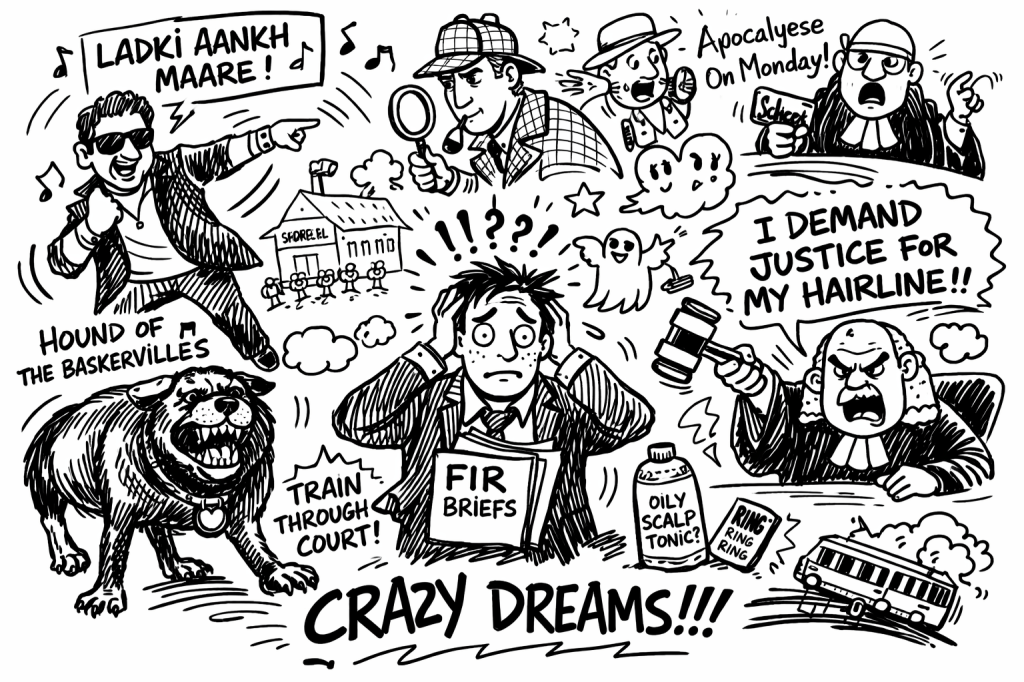
I am always anxious in dreams. Always on my toes. Always trying to solve something urgent and fundamentally absurd. One moment I am chasing the Hound of the Baskervilles through what appears to be old Noida mixed with Victorian England, and just when I am about to uncover the mystery, Arshad Warsi appears from nowhere, in full energy, dancing to Ladki Aankh Maare as if this is the most natural transition in the world.
And the worst part is that dream-me accepts it.
That is what concerns me.
There is no pause. No question. No intellectual resistance. My dreaming self never says, excuse me, what is Arshad Warsi doing in a Gothic murder investigation. No. Dream-me simply adjusts the collar, nods solemnly, and continues running as if this was all mentioned in the case diary.
Dreams have no respect for genre. They are lawless. They are the one place where tragedy, comedy, horror, Bollywood, paperwork, school trauma, old friendships, mythological references, and pending emotional damage all gather in a single municipal hall and start screaming over each other.
I have heard “order, order” in my sleep with more sincerity than I have heard in some actual rooms. In my dreams, judges are furious, but not about injustice, corruption, or the collapse of public morality. No. The judge is demanding justice for his receding hairline. He is personally wounded. He is looking at me with disappointment that stretches across generations. And I, an officer of this completely broken dream court, can offer him nothing except a gavel and perhaps some weak suggestions for oily scalp management.
That is the entire brief.
Not constitutional morality. Not equity. Not criminal liability. Hairline.
And yet in the dream it feels urgent. Nationally urgent. Historically urgent. Like if I fail to restore follicles to this man’s forehead, the republic itself will collapse by lunchtime.
This is what dreams do. They take your ordinary anxieties and dress them in circus clothes. You go to sleep with one manageable worry about work, money, family, health, or whether you said something awkward in 2018, and your brain turns it into a six-hour feature film where you are barefoot in a district court, your school principal is now the public prosecutor, your mother is driving a bus through a wormhole, and someone from your past is staring at you as if you have ruined their life by not replying to a text they never actually sent.
Dreams are not interested in coherence. Dreams are interested in atmosphere and emotional damage.
That is what makes them funny later and devastating in the moment.
Because while a part of me laughs at the sheer ridiculousness of it all, another part knows that dreams are built from scraps. They are stitched together from leftover fear. A worry about health becomes a collapsing staircase. A fear of failure becomes an exam hall. Guilt becomes a phone call you cannot answer. Grief becomes a house with one locked room. Stress becomes endless corridors. Responsibility becomes a child you are carrying through a crowd while everyone around you is either singing or setting something on fire.
And still, the dream insists it is all normal.
That may be the most insulting part of dreams. Their confidence.
In dreams, impossible things happen with bureaucratic calm. A tiger is sitting in your office chair. Fine. Your deceased relative is making tea in the kitchen. Understandable. Your old classmates are all judging your bank balance while a train passes through your living room. Of course. Somewhere a man with the face of your mathematics teacher is announcing that the apocalypse has been delayed till Monday due to administrative reasons.
And you just go with it.
Sleep is supposed to be rest. Whoever marketed it that way clearly never had an overactive mind. For some of us, sleep is unpaid overtime in a haunted department.
You do not sleep. You report for duty.
You close your eyes at night hoping for peace and your subconscious says wonderful, we have scheduled a crossover event. All your fears from the last fifteen years have arrived. They have name tags. They will now perform.
Sometimes I wonder whether dreams are the brain’s way of cleaning up. But if so, my brain is an extremely careless cleaner. It does not sort things gently. It picks up random emotional objects and throws them into one large bucket. A legal notice, one school memory, two episodes of panic, one old song, the face of a person you have not met in ten years, mild concern about hair fall, one historical author, a police siren, a childhood lane, and a vague feeling that you forgot something very important. Shake well. Serve at 3:17 a.m.
And then you wake up tired, as if you have not rested but testified.
There is also a peculiar loneliness to certain dreams. Even the funny ones carry a bruise. You wake up laughing at the absurdity, yes, but under the laughter there is often something softer and sadder. Why was I running so much. Why was I trying to fix everything. Why was I late. Why was everyone demanding something from me. Why did even the people in my dreams look like they expected me to solve what could not be solved.
That is when dreams stop being random entertainment and begin to feel like emotional audits.
No one admits this, but some dreams expose how tired you are. Not sleepy. Tired in the deeper way. Tired of holding everything together in waking life. Tired of appearing functional. Tired of being the person who must remember, answer, manage, explain, protect, provide, reassure, decide. In dreams, all that pressure returns wearing clown makeup.
So yes, it is funny that Arshad Warsi can suddenly appear in a gloomy detective chase and begin dancing with unearned confidence. But perhaps that is exactly how the mind copes. It knows that if it showed us our fears plainly, we would refuse to look. So it adds choreography. It inserts songs. It gives sorrow comic timing. It makes a spectacle out of strain so that we can survive seeing it.
Maybe that is why some of the saddest dreams are also the strangest. The heart cannot always speak directly. Sometimes it says, here is a judge angry about his hairline. Decode that yourself.
And we do.
Over morning tea, we sit with the wreckage and try to interpret it like underpaid philosophers. What did it mean that I was in school but also in court but also in a moving elevator in Budaun while someone played dhol in the background. Was it stress. Was it memory. Was it symbolism. Was it indigestion. The answer, most likely, is yes.
Dreams are ridiculous. They are theatre produced by panic and nostalgia. They are badly funded, poorly edited, emotionally ambitious projects. They make no sense and too much sense. They leave us amused, embarrassed, unsettled, exposed.
And still every night we return.
Because somewhere beneath all the chaos, the absurd juxtapositions, the strange casting choices, the dramatic background score, the impossible architecture, and the deeply unhelpful symbolism, dreams are trying in their own unhinged way to tell us something.
Maybe that we are overwhelmed.
Maybe that we miss people more than we admit.
Maybe that our minds are cluttered attics full of unfinished thoughts.
Maybe that fear itself is a storyteller.
Or maybe dreams are just the brain’s nightly open mic and we are unlucky enough to be seated in the front row.
Either way, if tonight I find myself once again in some semi colonial courtroom where Sherlock Holmes is filing a maintenance petition, a band is playing remixes in the corridor, my brief has turned into an FIR, and a deeply offended judge wants equitable relief for his receding hairline, I will do what any dignified adult would do.
I will stand up, adjust my invisible band, and say, with whatever courage remains in my sleeping soul, “My lord, on instructions, I seek a short pass over.”
Later. GTG.
 Expanding The Horizons